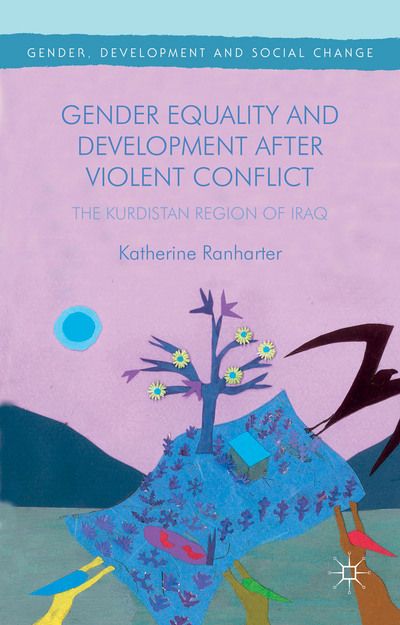
New Book: Gender Equality and Development After Violent Conflict – The Kurdistan Region of Iraq

27 09 2015

9781137528810Katherine Ranharter

Palgrave Macmillan, 2015

ISBN: 9781137528810 


The Kurdistan Region is at a unique point in its modern history. Isolation of the Kurds as an unheard minority is a thing of the past and the Region and its people are reaching new heights in international and internal recognition every day. As part of the ongoing transformation after conflict, the Region’s politicians have committed themselves to ensuring positive development for the entire population, including women, and to supporting the advancement of gender equality in their society. The author puts this assertion to the test by analysing the effects of gender-inclusive policies (or the lack thereof) deployed by the Kurdistan Regional Government in the areas of politics, the economy and education on the development of the Region and its people. The research builds not only on academic sources and policy material, but also on first-hand interviews with people in the Region.


Public Forum: Kurdish Question under European Union Law

9 09 2015

Kurdish-Progress-Logo-2The Centre for Kurdish Progress in partnership with the Centre for Turkey Studies cordially invites you to the public forum ‘Kurdish Question under European Union Law’ with Barrister Professor Bill Bowring of the Human Rights Centre, University of Essex and Mr Atilla Balikci of the Centre for Criminal Law and Criminology within Paris Nanterre University.

In this public forum, the speakers will examine the Kurdish issue from a legal perspective. According to Mr Balikci, typically, two trends monopolise attention in current debates about the Kurdish question. The first is that the Kurdish question is bounded geographically as it is considered to be either a “Turkish problem” or a regional deadlock. This approach is too restrictive, if not erroneous, because the Kurds have been dispersed across Europe since the early 1960s. Currently, an estimated two million Kurds live within the boundaries of Germany, Benelux, France, Switzerland, Austria and the United Kingdom. The second is that many analysts think of the Kurdish question within the framework of political science or geopolitics. Again, such approach is rather incomplete.

How do the Kurds perceive bans on their associations at the grassroots level? Has repression been a factor hindering their integration in Europe? How do the Kurds mobilise to overcome criminalisation? How is the Kurdish problem treated in diverse European legal contexts in which large numbers of Kurds reside? The speakers will address these questions in this public forum.

This event will take place on 21 September 2015, between 6.30 and 8.30pm, in Diskus Room of Unite House (128 Theobalds Road, Holborn, London, WC1X 8TN).

Speaker Biographies

Professor Bill Bowring teaches human rights and international law. His first degree was in Philosophy, from the University of Kent. He has been at Birkbeck since 2006. He previously taught at University of East London, Essex University and London Metropolitan University. As a practising barrister, he has represented applicants before the European Court of Human Rights in many cases since 1992. Bill has over 90 publications on topics of international law, human rights, minority rights, Russian law and philosophy, all from a Marxist perspective. His latest book is Law, Rights and Ideology in Russia: Landmarks in the Destiny of a Great Power (Routledge 2013).

Mr Atilla Balikci holds a BA in Private Law and an MA in Private Law and Criminal Sciences from Paris Ouest La Defense Nanterre University. Mr Balikci’s research interests include subjects of ‘terrorism’ and ‘fight against terrorism’ in relation to ‘national liberation movements’. He is currently a researcher in the Centre for Criminal Law and Criminology within Paris Nanterre University where he pursues a PhD project of his own on the ‘criminalisation of social movements’. Besides, Mr Balikci has successfully passed his bar exam and is now in the process of admission to the Bar of Paris, expected in September 2015.

When:

September 21, 2015 at 6:30pm – 8:30pm

Where:

Unite the Union
128 Theobalds Rd
Holborn
London WC1X 8TN
United Kingdom

For deatails click here. 


New Book: Media, Diaspora and Conflict – Nationalism and Identity Amongst Turkish and Kurdish Migrants in Europe

8 09 2015

9781784530396.ashxJanroj Yilmaz Keles

I.B.Tauris, 2015

ISBN: 9781784530396

For migrant communities residing outside of their home countries, various transnational media have played a key role in maintaining, reviving and transforming ethnic and religious identities. A vital element is how media outlets report and represent ethno-national conflict in the home country. Janroj Yilmaz Keles here examines how this plays out among Kurdish and Turkish communities in Europe. He offers an analysis of how Turkish and Kurdish migrants in Europe react to the myriad mediated narratives. A vital element is how media outlets report and represent the ethno-national conflict between the Turkish state and the Kurdish PKK.Janroj Yilmaz Keles here offers an examination of how Turkish and Kurdish migrants in Europe react to the myriad narratives that arise. Taking as his starting point an analysis of the nature of nationalisms in the modern age, Keles shows how language is often a central element in the struggle for hegemony within a state. The media has become a site for the clash of representations in both Turkish and Kurdish languages, especially for those based in the diaspora in Europe.

These ‘virtual communities’, connected by television and the internet, in turn influence and are influenced by the way the conflict between the Turkish state and subaltern Kurds is played out, both in the media and on the ground.By looking at first, second and third generations of Turkish and Kurdish populations in Europe, Keles highlights the dynamics of migration, settlement and integration that often depend on the policies of each settlement country. Since these settlement states often see the proliferation of such media as an impediment to integration, Media, Diaspora and Conflict offers timely analysis concerning the nature of diasporas and the construction of identity.

Click here for details. 


CEFTUS Westminster Debate on the Kurdish Issue: Is Peace Still on the Table?

5 09 2015

images-2Centre for Turkey Studies

27 October 2015, London

The Centre for Turkey Studies is delighted to invite you to a CEFTUS Westminster Debate with keynote speaker veteran journalist and author Mr Cengiz Candar and journalist and columnist Mrs Ezgi Basaran of daily Turkish paper, Radikal. This event will take place on 27 October 2015, between 7-9pm, in Committee Room 10 of the House of Commons.

Please see speaker biographies below.

Turkey’s hopeful Kurdish Peace Process that begun in 2013 may have come to an end in the summer of 2015. The start of the process had gained support across Turkey after having lost about 40.000 people in the conflict over 30 years. Following to June 2015 General Elections and ISIS bombing in Suruc, a town in eastern Turkey, violent clashes between Kurdistan Workers’ Party (PKK) and Turkish security forces erupted. Turkish government has taken a strong stance against terrorism of all types and responded harshly, especially after the killing of two policemen in their beds. In the meantime, Turkey’s pro-Kurdish party, People’s Democratic Party (HDP), which could pass the 10% electoral threshold in June elections, has faced accusations of direct links with terrorism and its mayors/councillors have been detained as well as the party has been threatened to close down. Whilst there have been concerning developments for democracy in Turkey, President Erdogan has called for elections to take place in November 2015 and declared that it is impossible to continue the peace process.

Mr Candar and Mrs Basaran will address the questions regarding the Kurdish peace process and what lies ahead for Turkey. They will analyse the Kurdish issue and the current political developments.

This debate is kindly hosted by Tom Brake MP for Carhshalton and Wallington.

The event will take place between 7-9PM on Tuesday, 27 October 2015 in Committee Room 10, House of Commons. Please note security checks are required to enter the House of Commons, at the Cromwell Green Entrance. We kindly ask you to arrive at 5.45PM to allow the event to start and end on time. Booking is required for this event to ensure adequate seating availability.

Please click ‘register’ above. Alternatively, RSVP to info@ceftus.org

Speaker Biographies

Cengiz Candar studied political science and international relations at Ankara University. He began his career as journalist in 1976 in Turkish daily Vatan after living some years in the Middle East and Europe due to his opposition to the regime in Turkey following the military intervention in 1971. An expert for the Middle East (Lebanon and Palestine) and the Balkans (Bosnia and Herzegovina), Candar worked for the Turkish News Agency and for Turkish newspapers Cumhuriyet, Hürriyet, Referans and Güneş as a war correspondent. Currently, he is a columnist for Radikal. Candar served as special adviser to Turkish president Turgut Özal between 1991 and 1993. His interest was drawn to the events during the ethnic unrest in the Balkans between 1993 and 1995. From 1997, Candar lectured for two years on “History and Politics in the Middle East” at Bilgi University in İstanbul. Between 1999 and 2000, he did research work on “Turkey of the 21st century” as a Public Policy Scholar at the Woodrow Wilson International Center for Scholars and a Senior Fellow at the United States Institute of Peace. His description of the 1998 events in Turkey as a “post-modern coup” gained notice internationally, though Radikal columnist Türker Alkan had used the term two weeks earlier.

Ezgi Başaran is an Istanbulite journalist and the editor-in-chief of Radikal, Turkey’s liberal quality digital paper. While a reporter for the Hurriyet, she won the Turkish Society of Journalists award for best investigative journalistic work at the age of 27. She has reported from Pakistan, North Osetia (right after the Beslan massacre), Armenia and Iran. After working for Hurriyet for almost eight years, she has become a part of Radikal. Since then she has been writing a column five times a week and also serves as the editor-in-chief. Her writings focus on the human rights violations in Turkey, the Kurdish problem, the Armenian issue and LGBT rights. As a prolific writer on these issues, she is an active participant of the public debate through her writings and national/international media appearances.

For details click here. 


Workshop: Dede Kargın War and the Ottoman-Kurdish Relations

1 09 2015

Mardin Artuklu University

March 2016, Mardin, Turkey

The Ottoman-Kurdish relations were mostly evaluated by scarce perspectives and within the framework of chosen historical developments because of the influences of ideological approachs. Therefore, some historical facts, which can be seen as significant milestones of Ottoman-Kurdish relations, were ignored. One of the important examples for this case is the Dede Kargın War and the developments after its occurance. Our workshop, which is related to a disregarded war and developments of its aftermath, and almost totally ignored by the specialists, both will fill a gap in the historical field and at the same time will assist us to evaluate the current related cases in a correct manner.

This workshop at its core will shed light on the Ottoman-Kurdish alliances against the Safavids in 1514-1515; the most explicit sign of these relations, Dede Kargın War; and the Kurdish Emirates, which were considered to stay in power until the second part of the 19thcentury, within the framework of the Ottoman-Kurdish relations. The intention of this workshop is to go beyond  the modern ideological cliches about the political alliances of the region, and to question these relations based on the first-hand resources. In this respect, the outcomes of this workshop are expected to contribute identification of the historical facts of the region in a well-grounded manner.

The participants of this workshop will be requested to have preferably a first-hand based research on the Ottoman-Kurdish relations primarily during the period of Sultan Selim I.

The current decided date for the workshop is March 2016. Details will soon be at offer. Any suggestions and contributions to the workshop before its program is announced will be welcomed.

(This workshop is supported by the Coordination Unit of Scientific Research Project(BAP) at Mardin Artuklu University.)

Contact: dedekarginwarworkshop@gmail.com

Dr. İbrahim Özcoşar

Erdal Çiftçi

M.Rezan Ekinci

Remzi Avcı


History of Iraqi Kurdistan Lecture Series

30 08 2015

General Poster AUDK


Call for Papers: Critical Approaches to the Peace Process in Turkey

25 08 2015

Trust24-25 March 2016, Coventry University, London Campus 

The “peace process” (çözüm süreci), also known as the Turkish-Kurdish peace process, is defined in the broad sense as a process of reconciliation and more narrowly as negotiations between the Turkish government headed by the Justice and Development Party (AKP) and the Kurdistan Workers’ Party (PKK). It aims to find a peaceful solution to the armed conflict that has been raging for the past three decades resulting in great loss of life and material and environmental destruction. The process that according to many started in 2012 could have potentially put an end to Turkey’s 90 years-long systematic policy of assimilation and securitization of the Kurdish identity and the PKK’s 30 year old insurgency. From its start, most commentators welcomed the idea of negotiations, while others declared their suspicions regarding the ultimate aims of the negotiating parties. Many perceived it as a positive achievement keeping in mind that there might be spoilers ahead and presidential, local or national elections might derail this initiative and put it to a more turbulent crossroad.

The process, extending over many rounds of talks, involved various “geographies”: from the Imrali prison island where the PKK leader Abdullah Öcalan is imprisoned, to Oslo where talks between representatives of the two parties were initially hosted, and the Dolmabahçe Palace, where deputies from the pro-Kurdish Peoples’ Democratic Party (HDP) and Deputy Prime Minister Yalçın Akdoğan presented a 10 point reconciliation declaration, and the Qandil mountains in Iraqi Kurdistan, where senior PKK members welcomed delegations from Turkey in their bases.

The peace process raised great expectations and hopes, and faced various setbacks due to lack of mutual trust, domestic and regional dynamics and upsurges in hostilities. On several occasions the talks were said to reach a turning point, either resulting in a collapse or break through. In July 2015, Turkey abandoned the peace process and resumed military operations against the PKK, hitting more than 400 targets in the first night of air-strikes only. The PKK retaliated by ambushing security forces inside Turkey, but also calling the masses to take responsibility for the peace process. The recent flaring-up of hostilities shows that a peace process is not a linear or even an irreversible process.

At the Conference “Critical Approaches to the Peace Process in Turkey” we aim to critically engage with the peace process, not so much focusing on “the right conditions”, assuming a universal template to be applied to conflict resolution, but instead identify and discuss variables relevant for the peace process in Turkey, ranging from weather conditions and broken transport vessels to amnesty, reform and disarmament, transitional justice mechanisms, reconciliation, forgiving, language and cultural revival to post-conflict reconstruction, to name just a few. What we try to accomplish through this approach is not to reason from other experiences to the Kurdish-Turkish process, indicating what is lacking or should happen from those perspectives, but to detail and explain the dynamics of the process in Turkey in all its complexity from a critical point of view. Rather than repeating already existing arguments and comparisons, we are interested in innovative approaches to this process, which may unpack the developments that have been experienced so far. This critical engagement also implies a thorough evaluation, a reasoning from the case itself, including a discussion of the peace process from a historical perspective, as a process of actors engaging with the politicization of a security discourse and the development of a war by other means, social and transitional justice, inclusiveness, exclusiveness and diaspora’s and other civil society actors’ role in this process.

In short, the conference is open to discuss everything that affects the course and content of the peace process and its outcomes. Those interested in presenting a paper are invited to send in an abstract before November 1, 2015 and their paper before February 15. See the timeline below for further details.

After the conference, we will prepare a special issue for a prestigious academic journal and therefore expect that the submitted papers are up to high academic standards.

Deadlines:
November 1, 2015: Latest date for submission of abstracts

December 1, 2015: Decisions communicated

January 15, 2016: Publication of draft program

February 15: Submission of conference papers (2,000 words)
June 1, 2016: Submission of journal article (6,000-8,000 words)

Registration dates:

November 1, 2015: Registration opens
January,1 2016: Early Bird Registration deadline
Registration fee: early registration 75 GBP (students 50 GBP)
Late registration 100 GBP (students 75GBP)

Organizers:

The conference is organized by Dr. Bahar Başer (Coventry University), Dr. Joost Jongerden (Wageningen University), and Dr. Welat Zeydanlıoğlu (Kurdish Studies Network/Kurdish Studies Journal).

Conference Venue:

Coventry University, London Campus. (Lloyds Building, 109-117 Middlesex St, London E1 7JF)

Submission:

Please submit your abstracts and queries to: PPTConference2016@gmail.com

CfP – Critical Approaches to the Peace Process in Turkey


KSN in FAZ

23 08 2015

886px-Frankfurter_Allgemeine_logo.svgOn 12th August 2015 the leading German paper Frankfurter Allgemeine Zeitung (FAZ) featured an article on the Kurdish Studies Network (KSN). In his article Joseph Croitoru provides an introduction to the interdisciplinary research network which brings together scholars from across the world, followed by its activities such as the peer-reviewed journal, Kurdish Studies, and its unique bibliography. The writer also reviews a recently published article in the latest issue of the Kurdish Studies.

The Awakening of Kurdology – The Early Years of the PKK

Joseph Croitoru, Frankfurter Allgemeine Zeitung, 12th August 2015

Kurds’ geographical dispersion and internal political disputes have left an impact on the study of Kurdish culture, yet the Internet has brought Kurdologists together again. As of 2009 Turkish-Kurdish historian Welat Zeydanlioglu brought the Kurdish Studies Network (KSN) at a conference at the University of Exeter into being, where an institute for Kurdish Studies had been established three years earlier. The research network, consisting of around one thousand researchers, journalists, and activists informs on its website about the different areas of this research field and lists continuously, starting from the nineteenth century, the most important publications in the field.

Since 2013, the KSN also publishes the interdisciplinary scientific online journal Kurdish Studies. The free-access publication shall be spared the fate of earlier Kurdology periodicals that had appeared in print. The Kurdische Studien of Berlin and the Journal of Kurdish Studies, published in the Belgian Leuven, ceased in 2005 and 2008 respectively.

In the preface to the first edition of the Kurdish Studies, Dutch expert on Kurds Martin van Bruinessen raised the merits of this research initiative. Unlike the mentioned Kurdish Studies Institute in Exeter, supported by the Iraqi Kurdish Patriotic Union of Kurdistan (PUK), and also unlike the relatively new Kurdology lectureship at the American University Washington, named after the founding father of the rival Kurdish Democratic Party (KDP), Mustafa Barzani, the research network is distinguished by its political independence. It has quickly become a “virtual Institute of Kurdish Studies”, partially compensating the lack of relevant research institutions in Western universities.

The recent about a dozen articles of the journal mostly deal with the settlement areas of the Kurds, which was subject of earlier research concentration: Turkey and Iraq. The Kurdish minority in Syria and in Iran are dealt with rather marginally. Ground-breaking are the considerations of the Kurdish Question from a regional and global perspective, as well as the comparative approach of some essays. This includes the demonstration of similarities between the Kurdish case and the ethno-national movement of Berbers in North Africa, and analysis of the relations between these two ethnic groups to their respective diaspora communities.

The article in the latest issue (Number 3, 2015) “The Palestinian Dream in the Kurdish Context” by Ahmet Hamdi Akkaya, conflict researcher originating from Turkey, has been published in this context. Akkaya, who researches in Ghent on the history of the Kurdistan Workers’ Party (PKK), examines the links between leftist Turkish and Turkish-Kurdish activists, mainly from the ranks of the PKK, with the Palestinian liberation movement in the seventies and eighties. This relationship was commonly known to have existed, yet little was known about its exact structure. Already in the late sixties several members of the Workers’ Party of Turkey, the first socialist party entering into the Turkish Parliament, travelled to the training camps of the Palestinian Fedayeen fighters in Jordan. In addition to the anti-imperialist left impetus, it was also adventurousness that played a central role, which brings to mind the motives of today’s foreign jihadists of Syria or Iraq.

By far, more ideologically motivated were those travel waves of leftist Turkish and Kurdish revolutionaries to Palestinians training camps in Lebanon, triggered by the military coups of Turkey in 1971 and 1980. In those days the PKK members mainly received military training by the Democratic Front for the Liberation of Palestine, which PKK leader Abdullah Öcalan contacted in 1979 during his escape to Syria. By 1982 their numbers grew to around three hundred. Some of them fought together with the Palestinians against the Israeli army, which had invaded Southern Lebanon.

As Akayya describes, the Israeli invasion indirectly helped the PKK to gain new strength. Although their fighters had already previously received wages from the Fedayeen, these in turn were passed on to Öcalan’s organization, consolidating them financially. As such they easily gained possession of hundreds of kalashnikovs from Palestinians and South Lebanese hiding underground, who wanted to get rid of them due fears of the Israeli occupying forces. The former Syrian President Hafez readily left the PKK smuggling these weapons into Turkey, causing in the long term a destabilization of the region. The latest development shows that he had backed the wrong horse. The Northern Syrian Kurdish areas have now withdrawn from the reign of his son Bashar and are now controlled by PKK offshoots.

(Translated from German by Ethem Coban. For the German version click here).


Conference: United Kurdistan – Distant Dream or Emerging Reality?

8 08 2015


logo-2The Association for the Study of the Middle East and Africa is pleased to invite you to attend the forthcoming Eighth Annual Conference of the Association for the Study of the Middle East and Africa (ASMEA) featuring addresses by H.E. Bayan Sami Abdul Rahman, Kurdistan Regional Government Representative to the United States, and the Honorable Dr. Kemal Kirkuki, former Speaker of the Kurdistan Parliament. Both will deliver remarks in the context of this scholarly event designed to promote understanding about Kurdistan and the whole of the Middle East. The conference will take place October 29 – 31, 2015in Washington, D.C.

In addition, the topic of a rising Kurdistan will be covered in a policy roundtable at this event titled, United Kurdistan: Distant Dream or Emerging Reality? Several additional scholarly panels will feature paper presentations on a variety of topics including:

  • The Kurds of Syria: From Marginalization to Center Stage
  • Neo-Ottomanism and the Kurdish Issue in Turkey: State Policy and Kurdish Response
  • The Kurdish Women of Rojava: Building a Nation in the Chaos of War
  • The Turkish Government’s Policy of Denial Towards the Kurds and the Reflections of this Policy in School Textbooks
  • The Kurdish Republic of 1946 and its Impact on Modern Kurdish Movements

With its long history of supporting discussion on all facets of Kurdistan and the Kurdish experience ASMEA is proud to help its members -scholars, students, foreign policy practitioners, and interested citizens- gain further insights about the Kurdish people.

To register for the conference please go to www.asmeascholars.org and click on “conference” by September 30, 2015 to receive discounted rates.


Call for Papers: Sinjar/Shingal, One Year On

6 08 2015

Theme: Sinjar/Shingal, one year on; Peacebuilding in Kurdistan amidst local and regional conflicts; Arab-Kurdish relations; Exploring Innovative, Diverse, and Inclusive Efforts in Peace and Human Security in Kurdistan. 

Guest Editors for the Peace and Justice Studies Association: Dr. Victoria Fontan, Professor of Peace and Conflict Studies, American University Duhok Kudistan; and Victoria Henckenlaible, Program Associate, Centre for Peace and Human Security, American University Duhok Kurdistan.

The Peace Studies Journal is an international interdisciplinary free online peer-reviewed scholarly journal.

In August 2014, the Sinjar/Shingal region of Iraq was stormed by the Islamic State group, which targeted its Ezidi population and displaced more than two million people. More than five thousand women and girls were enslaved and an equal number of civilians were killed. While at first scores of international NGOs flocked to Duhok in the Kurdistan Region of Iraq, results are mixed one year on. In this special edition, edited by the Centre for Peace and Human Security at the American University Duhok Kurdistan, we seek contributions that examine the impact that the Sinjar/Shingal crisis has had on the region, its population, as well as the peace-building initiatives that have taken place. How can the disciplines of Peace and Human Security be informed by the Sinjar/Shingal crisis? What are the lessons learned and the opportunities for future crises? In this edition, we also wish to highlight the courageous work of local communities, educators, and activists seeking to live, teach, and make peace in the Kurdistan region of Iraq and beyond.

We invite original, unpublished articles, book and film reviews, as well as non-traditional formats (poetry, dialogues, and more). Every submitted article will be subject to anonymous peer review and recommendations. Additionally, we are seeking peer reviewers (available from October 1st, 2015) to evaluate and make recommendations about proposed contributions.

Possible topics linked to the theme include (but are not limited to):

  • How have international and local peace initiatives impacted the Ezidi and Kurdish population?
  • What has been the impact of the Sinjar/Shingal crisis regarding Arab-Kurdish relations?
  • How do regional powers fare in relation to peace and human security in the Kurdistan Region of Iraq?
  • What are the lessons learned from peace building after Sinjar/Shingal?
  • How does the international focus on sexual violence in Sinjar/Shingal impact its victims?
  • One year after Sinjar/Shingal, what is the way forward for the Kurdistan Region of Iraq?

Submissions of articles (2,000-10,000 words), film, book, art and other media reviews (maximum 3,000 words), interviews and dialogues (1,000-10,000 words), poems (less than 10,000 words) or other contributions should be submitted to Dr. Victoria Fontan at victoria.fontan@audk.edu.krd AND to Victoria Henckenlaible at victoria.henckenlaible@audk.edu.krdno later than October 1st, 2015.

Additional guidelines for submissions:

  • All submissions should have appropriate references and citations. Manuscripts should be single line spacing, 12-point font and conform to the American Psychological Association (APA) style format with no footnotes or endnotes.
  • Submissions must be sent in Microsoft Word format. Submissions in other software formats will not be reviewed.
  • Authors should remove all self-identification from their submissions, but all submissions must be accompanied by a title page with author(s) name and affiliation, name of type of submission (e.g., article, review, conference summary, etc.), contact information including e-mail, postal address, and phone number.
  • Authors must include an abstract of no more than 150 words that briefly describes the manuscript’s contents.

For more information about the Peace Studies Journal, published by the Central New York Peace Studies Consortium, see http://peaceconsortium.org/peace-studies-journal


Call for Papers: Migration and Sexuality

26 07 2015

Spatial movements are often associated with changes in preferences, norms and practices. These changes often involve the most intimate spheres, both through selective adaptation of native sexual subcultures and through experimentation with new opportunities and constraints.

There is nothing new in the interest for the transformation of intimate norms and practices during migration. A century ago, the Chicago School had already highlighted the role of spatial mobility in shaping changes in sexual norms and practices. Even Kinsey, in his pioneering work, duly stressed migration experiences as potentially significant for explaining sexual behavior.

Still, a sustained dialogue between sociologists of migration and sociologists of sexuality is largely missing. Scholars working in one of these fields often ignore substantial findings identified by the other. Only in recent years, a seminal stream of bridging literature has been slowly emerging. We are still, however, far from having an adequate understanding of the issue.

The session Migration and Sexuality will offer a venue for all social scientists doing empirical work on the connections between sexual behavior and migration experiences. Scholars from other disciplines – from anthropology to social history – are also welcomed. The ideal paper will deal with analytically well-defined changes in sexual life (broadly defined as changes in sexual identities, norms, networks of sociability, meaning, practices) brought about by migration. There is no preference for given specific methods or research techniques. Priority, however, will be given to papers having a solid empirical research focus.

The session will take place within the 3rd Forum of Sociology organized by the International Sociological Association. It is part of the program of Research Committee 31 Sociology of Migration. Information on the Forum and organizational details are available at  http://www.isa-sociology.org/forum-2016/

The deadline for the submission of abstracts is September 30th, 2015. Abstracts must be submitted through the Forum website, https://isaconf.confex.com/isaconf/forum2016/cfp.cgi. All papers accepted will be notified by 30th November, 2015.

Session organizers

Martina Cvajner, Università di Trento, Italy, martina.cvajner@unitn.it

Giuseppe Sciortino, Università di Trento, Italy, giuseppe.sciortino@unitn.it


The Situation of Genocide-surviving Women – From Anfal to ISIS

16 07 2015

8785f102c2d2dc7274eaf73f0bfbddacThe Centre for Gender Studies (CGS) at SOAS University of London invites you to a talk & poetry reading by Dr Choman Hardi on Monday 20 July 2015, 6pm in room B102 (Brunei Gallery, SOAS).  

The situation of genocide-surviving Women, from Anfal to ISIS, 

Genocide is a violent process of destruction and rupture, which leads to the creation of a traumatised and isolated underclass. It enhances the social and political inequalities already inherent in society.  Addressing the challenges faced by women survivors of genocide requires recognising the links between the social, psychological and the physical domains of life. It requires acknowledging a past full of injustice, violence, and loss as well as tackling the survivor’s existing low socio-economic status. This talk will compare the situation of Anfal and ISIS surviving women in Iraqi Kurdistan.

***

Bio

Choman Hardi is a member of faculty at the American University of Iraq, Sulaimani (AUIS). She was educated in the universities of Oxford (BA, Philosophy and psychology), London (MA, Philosophy) and Kent (PhD, Mental health). She was awarded a scholarship from the Leverhulme Trust to carry out her post-doctoral research about women survivors of genocide in Kurdistan- Iraq. The resulting book, Gendered Experiences of Genocide: Anfal Survivors in Kurdistan-Iraq (Ashgate, 2011), was chosen by the Yankee Book Peddler as a UK Core Title.

Hardi has published collections of poetry in Kurdish and English. Her first English collection, Life for Us, was published by Bloodaxe Books in 2004. In 2007 one of her poems from this collection, ‘My children’, was featured on Poems on the Underground in London. In 2010 four poems from the same collection were included in the English GCSE curriculum (AQA and Edexel). In August 2014, another poem, ‘Summer Roof’, was chosen by London’s Southbank Center as one of the ‘50 greatest love poems of the past 50 years’. In November 2014 she was awarded The Woman’s Prize by Andesha Cultural Centre in Sulaimani for her academic and creative achievements. Her forthcoming collection, Considering the Women, will be published by Bloodax Books in 2015.


Call for Papers: The Politics of Language

11 07 2015

logoIPSA-AISP 2016 World Congress, Istanbul, Turkey  

The Research Committee on the Politics of Language (RC50) (http://rc50.ipsa.org/) is now inviting paper proposals for the International Political Science Association’s 24rd World Congress (Istanbul, Turkey, July 23-28, 2016) on the following themes:

  • Language Regimes and Citizenship Regimes: Bridging the Gap
  • Justice for Linguistic Minorities: Theories and Practices
  • Language and Party Politics
  • Language and Political Science
  • The Commodification of Language
  • The Politics of English Language Education
  • Linguistic Justice from the Ground Up
  • Language Politics in Africa
  • Linguistic Diversity and Economic Development
  • Language Regimes: Case Studies and Theoretical Understandings
  • Language Revitalisation and State Transformation
  • Social Mobility, In-Migration and Minority Languages Communities
  • Politics of Official Language Policies
  • The Politics of Language and Regional Integration in Comparative Perspective
  • Language Politics in Turkey

For more information on the thematic topics, see panel descriptions on the RC50 website at http://rc50.ipsa.org/

Interested parties should send a 250-word abstract to Selma K. Sonntag (Selma.Sonntag@humboldt.edu) and Jean-François Dupré (rc50ipsa@gmail.com) by September 11, 2015.

Authors of accepted paper proposals will receive an email invitation in early October, 2015.  Upon receipt of this invitation, each presenter will be responsible for uploading his or her proposal through the IPSA website.

For more information about the World Congress, including registration costs, please visit

https://istanbul2016.ipsa.org/events/congress/istanbul2016/home

To download this call for papers: IPSA_Istanbul_2016_CFP_AISP_Istanbul_2016_AdC.pdf

To download and view panel descriptions: IPSA2016_Panel_Descriptions_Website.pdf


Conference: Istanbul Human Security Conference

8 07 2015

CTPSR_IHSCThe Role of Non-State Actors in Building Human Security: Opportunities and Challenges Ahead will be taking place on: 20-21 October 2015.

As a close collaboration between the Centre for Trust, Peace and Social Relations (CTPSR) at Coventry University, the United Nations Human Security Unit and Kadir Has University in Istanbul, the conference will be hosted by Kadir Has University in Istanbul. Panel sessions address four conference themes  in innovative and interactive formats to engage both the academic and practitioner communities.

THEME 1: DEVELOPMENT

This theme aims to reflect and explore effective strategies of incorporating non-state actors into development visions.   Where do development and heightening human security projects intersect? What are the tensions between non-state actors, human security and development?

THEME 2: HUMANITARIAN AID

Humanitarian aid is part of the efforts to ensure human security. This theme aims to explore the role of humanitarian aid agencies within the human security context. What is the role of humanitarian aid in human security? How can humanitarian aid agencies heighten human security? Can humanitarian aid agencies contribute to human insecurity?

THEME 3: DISASTER MANAGEMENT

Natural disasters are increasing in number and scale. This theme aims to explore the mechanisms that can enhance the involvement of non-state actors in heightening human security and lessening the threats to it. How can states cooperate with non-state actors in disaster management? How can we increase the effectiveness of donors, international organizations or local or transnational NGOs?

THEME 4: PEACEBUILDING

Peacebuilding plays a fundamental role in increasing human security in post-conflict societies. This theme aims to explore the ways in which non-state actors take part in such efforts. How do policy makers react to the involvement of non-state actors in peacebuilding efforts? What are the challenges and benefits of getting non-state actors such as civil society organizations, international organizations or transnational networks involved in peacebuilding? In which ways do they act differently then state-linked actors?

Click here for details. 


Kurdish Studies at Turkish Migration Conference 2015

1 07 2015

ks_editors2015Kurdish Studies’ strong appearance at the TMC 2015 in Prague: A rich array of research presented over three days by academics from around the world, 29 June 2015– Prague, Czech Republic 

Turkish Migration Conference 2015 ended on a high note on Saturday evening with a traditional Czech dinner at Plzenska Restaurant in Municipal House of Old Town Prague city centre. The conference proved to be a great event facilitating debates and setting the agenda for research and policy in human mobility, conflict and integration with particular reference to migrants from Turkey and recent flows of movers to Turkey. Ibrahim Sirkeci, Conference Chair and Ria Financial Professor from Regent’s University London said: “this is a conference where we promote friendly and frank scholarly exchanges to foster research in the field”. The third conference in the series attracted over 200 papers from all over the world and a lively event saw nearly 140 presentations at Jinonice campus of the historic Charles University Prague in three days. Three editors of Kurdish Studies journal, Welat Zeydanlioglu, Ibrahim Sirkeci and Joost Jongerden have chaired several special sessions on Kurdish migration and Kurdish diaspora. The three-day conference kicked off on Thursday morning with keynote speeches by two gurus of migration studies: Douglas Massey of Princeton University and Caroline Brettell of Southern Methodist University have discussed irregular migration, migration trends, citizenship, theory development and offered an opportunity to compare and contrast Turkish and Kurdish mobility experiences.

Kurdish Studies participation in the Turkish Migration Conference was not only significant in numbers but also rich in content. Dr Zeydanlioglu said that “the quality of papers presented were good and promising for the field”. Research presented included a wide range of topics from language to spatial politics and the imagining of home, from women’s agency to diasporic identities and community building. The interdisciplinary character of the conference, and the complementary character of the presentations, from the tiny of the local to the immense of the global, makes the conference an important event for all those interested in Kurdish studies as well as human mobility. Importantly, the spatial turn in social sciences also has put its stamp on Kurdish Studies and the Turkish Migration Conference. This turn has directed our attention away from exclusively time oriented theories of succession to spatial theories of simultaneity and difference and opens up a whole new research agenda. Prof Sirkeci discussed “the importance of studying and interpreting human mobility with a conflict perspective to be fair to the dynamic nature of population movements and processes which was very clear in the experiences of Kurdish movers from Turkey”. Dr Jongerden said: “A potential was obvious for, the Kurdish Studies panels within TMC which may turn into a parallel one or two days conference within the TMC event in the near future”.

Conference co-chairs and local organisers, Dr Wadim Strielkowski and Inna Cabelkova from Charles University Prague, Faculty of Humanities have underlined the growing importance of Turkish migration studies in Eastern Europe in recent years. The deputy Dean of the Faculty welcomed the participants at the opening plenary session.

Michael Murad with his paper entitled “Kurdish Community in the Czech Republic and its Transnational Practice” was awarded the best student paper prize while Dr Maria Six-Hohenbalken with her paper “Transnational Spaces between Dersim and Vienna” was selected for the best conference paper of TMC 2015.

The Turkish Migration Conference was hosted by Charles University Prague in Czech Republic and supported by Regent’s Centre for Transnational Studies of Regent’s University London, Gifford Centre for Population Studies of University of California Davis as well as Transnational Press London, University Service Publishing.

About Kurdish Studies journal
Kurdish Studies journal was launched back in 2013 and quickly became the leading outlet for studies on the Kurds. Articles are published with Kurmanji and Sorani abstracts in the journal. The second issue of the Journal’s third volume is dedicated to articles on Kurdish diaspora to appear later in the year. Kurdish Studies is published by Transnational Press London and supported by scholars of the Kurdish Studies Network. Conference details can be seen at www.turkishmigration.com.
Find out more about Kurdish Studies at: www.KurdishStudies.net.

Contact:
Professor Ibrahim Sirkeci and Dr Welat Zeydanlioglu
T. +44 7875211052
E-mail: sirkecii@regents.ac.uk & editor@kurdishstudies.net

Click here for details.


Discussion: Stateless Nations – A Case Study of Kurdistan

18 06 2015

unilogo_253.png


A discussion on emergence of stateless nations particularly the Kurdish nation divided between four states of Iraq, Turkey, Syria and Iran. The event will deal with the question of Kurds as a stateless nation and focus particularly on developments in Kurdistan within Iraq. What is the future of Iraq as a state? Are we witnessing a move toward an independent Kurdistan or is the status quo of Kurdistan Regional Government within Iraq going to continue?

Date and time: Thursday 25 June 2015, 6-8pm

Location: Westminster Forum, University of Westminster, 32-38 Wells Street, London W1T 3UW, UK

About the speaker: Gary Kent is a Labour friend of Iraq as well as Kurdistan who has worked in the Parliament for 25 years. He is also the Administrator of the All-Party Parliamentary Group on the Kurdistan Region in Iraq and a writer for Rudaw which is Kurdistan’s top media network.

Chair: Dr Dibyesh Anand, Head of Department of Politics and International Relations, University of Westminster

Organiser: Yadgar Merani, a current student of BA Hons Politics and International Relations, University of Westminster

RSVP: If you are a member of public and not from University of Westminster, you are welcome but please send an email with your full name to dpir.westminster@gmail.com

Click here for details.


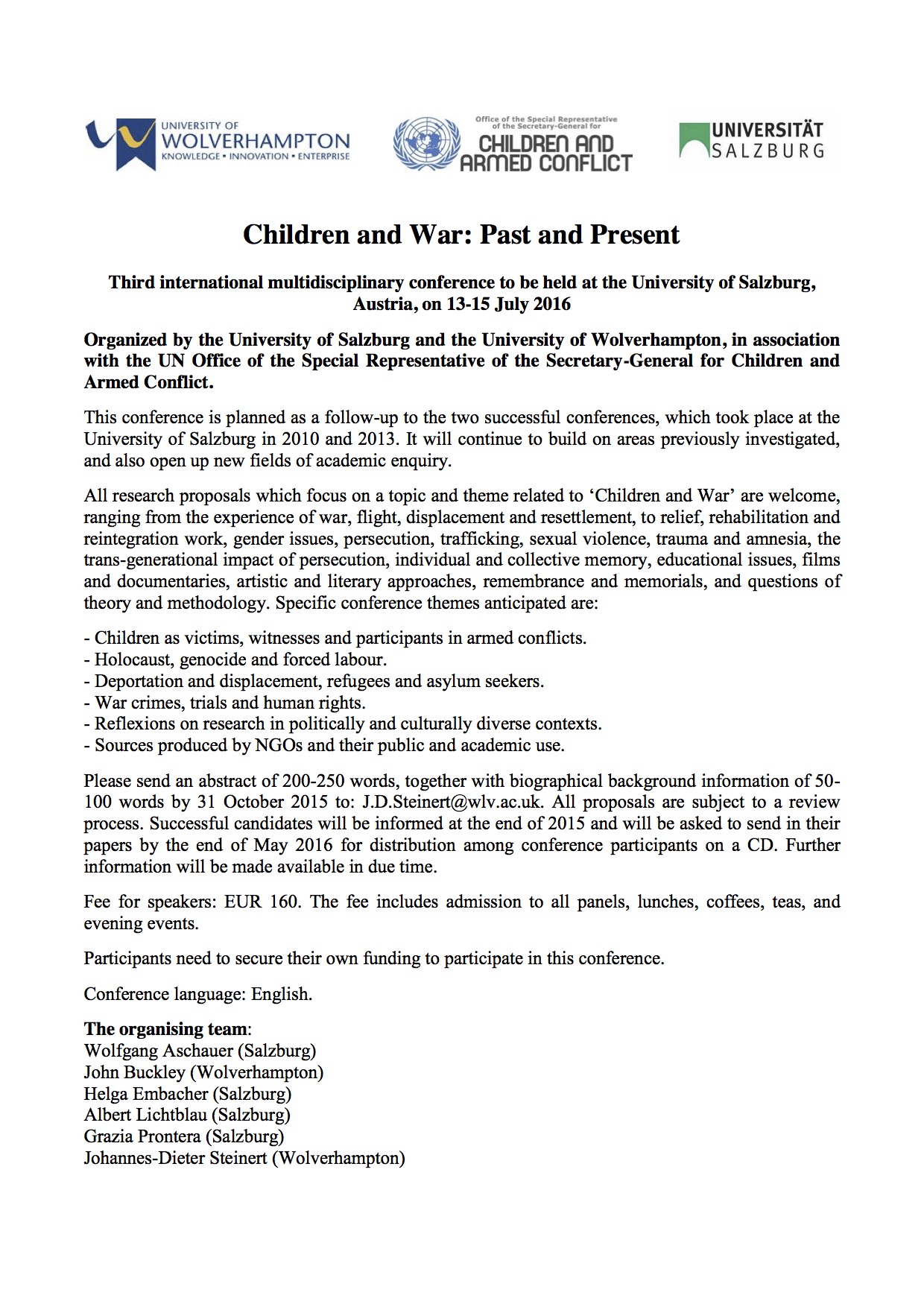
Call for Papers: Children and War – Past and Present

18 06 2015

CfP - Children and War 2016


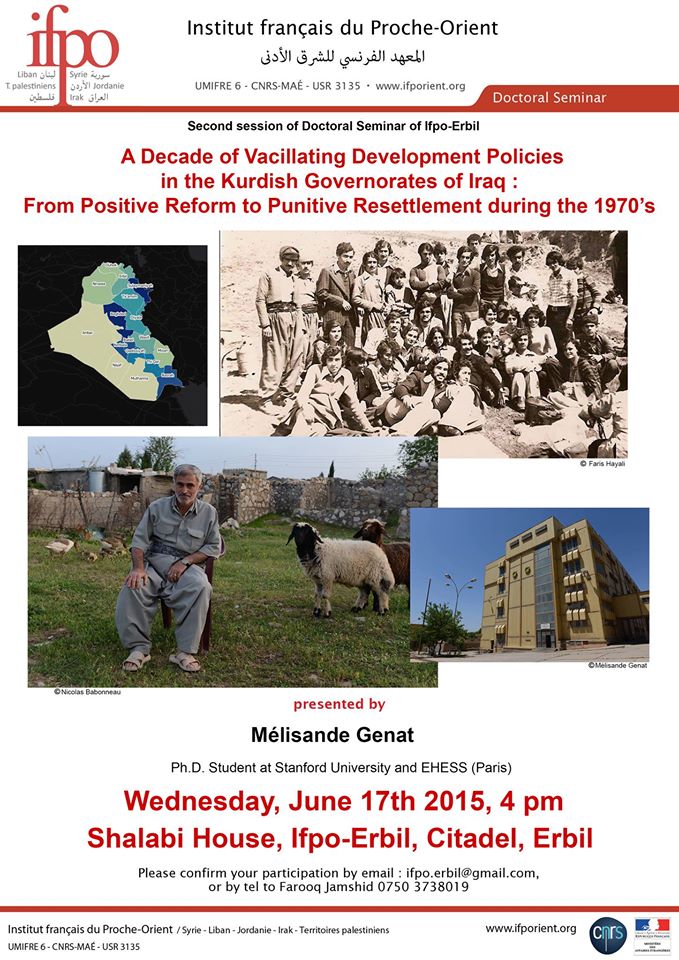
Doctoral Seminar: A Decade of Vacillating Development Policies in the Kurdish Governorates of Iraq – From Positive Reform to Punitive Resettlement during the 1970’s

14 06 2015

11402578_1589657454630569_2108667074574447481_o


Workshop: Minorities and Popular Culture in Modern Middle East

12 06 2015

8785f102c2d2dc7274eaf73f0bfbddacThanks to modern mass communication media and commercial entertainment, popular culture has increasingly become a large industry geared for massive consumption while engendering and contesting national and communal identities. Since late nineteenth century, Middle Eastern minorities have contributed to the making of popular culture industries as public performers, producers, writers, filmmakers, musicians, etc.  Meanwhile, popular culture has been a crucial tool in constructing public imagery of both majority and minority ethnic and religious communities. Thus, popular culture has been a site of contradictions and contestations. This workshop aims at exploring the contribution of all religious and ethnic minorities to the popular culture industries and how popular culture products have represented minorities and dealt with the minority question in modern Middle East during the twentieth century and at present. The workshop hopes to examine national, regional, and cross-regional case studies covering the area from Iran to Morocco, from Turkey to Sudan and beyond. Comparative and diasporic studies are particularly welcome.


Venue: SOAS, University of London Brunei Gallery, room B102

Date: 12-13 June 2015

Click here for details.


New Book Out: Honour-Based Violence – Experiences and Counter-Strategies in Iraqi Kurdistan and the UK Kurdish Diaspora

2 06 2015

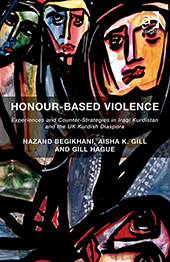
9781409421900.PPC_PPC TemplateNazand Begikhani, Aisha K. Gill & Gill Hague 

Ashgate, 2015

978-1-4094-2190-0

‘Honour’-based violence is a form of intimate violence committed against women (and some men) by husbands, fathers, brothers and male relatives. A very common social phenomenon, it has existed throughout history and in a wide variety of societies across the world, from white European to African cultures, from South and East Asia to Latin America. The most extreme form of Honour-based violence – ‘honour’ killing – tragically remains widespread.Over the last decade, national and international efforts, including new policy development and activist campaigns, have begun to challenge the practice. Based on a pioneering and unique study, conducted collaboratively by the Centre for Gender and Violence Research, University of Bristol, the University of Roehampton and Kurdish Women’s Rights Watch, this book is at the forefront of this new and challenging policy direction.

Contents: Foreword, Fatma Müge Göçek; Understanding and challenging ‘honour’-based violence; Defining and responding to honour-based violence and patriarchal social relations; The context: Iraqi Kurdistan region; The nature of HBV and women’s voices from Iraqi Kurdistan; Media representation of honour-based violence; Honour crimes and Kurdish women in the diaspora; Issues for law, policy and practice in Iraqi Kurdistan; Conclusions: moving forward; Appendices; Bibliography; Index.

About the Authors: Dr Nazand Begikhani, University of Bristol, UK, Dr Aisha K. Gill, University of Roehampton, UK and Professor Gill Hague, University of Bristol, UK.

Click here for details.