New Book Out: Kurdish Awakening – Nation Building in a Fragmented Homeland

2 12 2014

9780292758131Ofra Bengio

University of Texas Press

ISBN: 978-0-292-75813-1

Kurdish Awakening examines key questions related to Kurdish nationalism and identity formation in Syria, Iraq, Iran, and Turkey. The world’s largest stateless ethnic group, Kurds have steadily grown in importance as a political power in the Middle East, particularly in light of the “Arab Spring.” As a result, Kurdish issues—political, cultural, and historical alike—have emerged as the subject of intense scholarly interest. This book provides fresh ways of understanding the historical and sociopolitical underpinnings of the ongoing Kurdish awakening and its already significant impact on the region.

Rather than focusing on one state or angle, this anthology fills a gap in the literature on the Kurds by providing a panoramic view of the Kurdish homeland’s various parts. The volume focuses on aspects of Kurdish nationalism and identity formation not addressed elsewhere, including perspectives on literature, gender, and constitution making. Further, broad thematic essays include a discussion of the historical experiences of the Kurds from the time of their Islamization more than a millennium ago up until the modern era, a comparison of the Kurdish experience with other ethno-national movements, and a treatment of the role of tribalism in modern nation building. This collection is unique in its use of original sources in various languages. The result is an analytically rich portrayal that sheds light on the Kurds’ prospects and the challenges they confront in a region undergoing sweeping upheavals.

Click here for publisher’s website


Call for Papers: XV International Conference on Minority Languages (Belgrade, 28-30 May 2015)

27 11 2014

XV INTERNATIONAL CONFERENCE ON MINORITY LANGUAGES

grb-100-x-100jpgThe Faculty of Philology of the University of Belgrade is pleased to announce the 15th International Conference on Minority Languages (ICML XV) which will be held in Belgrade, Serbia, May 28-30, 2015.

Conference theme:
Minority languages in education and language learning: challenges and new perspectives

International conferences on minority languages have been taking place on a regular basis since 1980. Their focus has always been on the minority languages, and with special emphasis on European values of multilingualism and plurilingualism, and in line with European initiatives and documents regarding the maintenance, status, revitalization and place and role in educational systems of these languages.

“The series of International Conferences on Minority Languages offer an opportunity to discuss various disciplinary approaches. Good research practices are transmitted and disseminated. Effective use of dialogue and deliberation leads to an increase in policy formulation and basic research.” (Gorter, 2009, p. 37)

The theme of the 15th ICML is the place and role of minority languages in formal and informal educational settings. It has been established in academic literature and in democratic practices that the presence of minority languages (which serve as languages of primary socialization) in the educational systems brings very important benefits to children of those ethnolinguistic minority groups in terms of both cognitive and academic progress. This conference aims at fostering communication among theoreticians and practitioners in minority language learning and teaching across Europe and aims at designing IT tools for promotion of minority language learning and teaching in different socio-cultural contexts.

The primary objective of the 15th ICML is to look at results achieved so far, recognize examples of good practice and identify problems and challenges and propose new perspectives in the area of minority language education. The organizers are hoping to bring together new theoretical approaches and practical models of minority language education European and world-wide perspective.

A number of workshops promoting ethnolinguistic minorities living in Serbia which would help us all recognize and value ethnolinguistic diversity in our country are planned for the duration of the 15th ICML in Belgrade, in collaboration with different national and international cultural and academic institutions in the city.

The conference is organized, but not restricted to the following topics within the above outlined general theme:

• Languages of early childhood education of ethnolinguistic minorities: curriculum design and development
• Languages of early childhood education of ethnolinguistic minorities: legal perspectives
• The role of majority languages in education of ethnolinguistic minorities

• ICT in education in minority languages
• Primary and secondary bilingual education of children from
ethnolinguistic minorities:

While ICML XV in Belgrade will continue the tradition of ICML to discuss these questions with respect to minority languages of Europe, this conference also sets out to expand the scenery of ICML and therefore especially invites proposals concerning the study of minority languages in other parts of the world.

CALL FOR PROPOSALS
Proposals regarding original and previously unpublished research on minority languages are invited in two formats: colloquia and individual papers. Proposals should fall broadly within the conference theme.

Proposals for colloquia
Colloquia are collections of paper presentations that relate to a narrowly defined topic of interest, and are offered in a three-hour time block. Proposals for colloquia are limited to 700 words, and should include brief summaries of each of the papers to be included, along with paper titles and individual authors’ names. Sufficient detail should be provided to allow peer reviewers to judge the scientific merit of the proposal. The person submitting a proposal for a colloquium is responsible for securing the permission and co-operation of all participants before the proposal is submitted. A chair for the session must also be identified. Please submit your proposal in English. The submission deadline for proposals for colloquia is November 30, 2014. Submissions should be sent to xvicml@fil.bg.ac.rs. Please specify in the subject line: abstract submission for colloquium.

Proposals for individual papers
Please submit by e-mail a one-page (500-word) abstract of your paper, including your name, affiliation, address, phone and e-mail address at the end of your abstract. The abstract should include enough detail to allow reviewers to judge the scientific merits of the proposal. All abstracts will be reviewed anonymously by the members of the Scientific Committee of ICML XV. We will accept for presentation by each author: (a) a maximum of one first authored paper and (b) a maximum of two papers in any authorship status. Oral papers will be allotted 30 minutes, allowing 20 minutes for presentation and 10 minutes for questions. The official language of the conference is English. The submission deadline for proposals for individual papers is December 31, 2014. Submissions should be sent toxvicml@fil.bg.ac.rs. Please specify in the subject line: abstract submission for individual paper.

Acknowledgement of receipt of abstracts and proposals for colloquia will be sent by e-mail as soon as possible after the receipt. You will receive notification of acceptance of individual papers or colloquia as soon as possible but no later February 28, 2013.

Conference registration fee is 70 euros. Conference registration fee for students is 40 euros. Our conference website will soon go online at
http://www.fil.bg.ac.rs/lang/sr/fakultet/naucni-skupovi-i-konferencije/ 


Call for Paper: Multidisciplinary Approaches in Language Policy and Planning Conference 2015

23 11 2014

Multidisciplinary Approaches in Language Policy and Planning Conference 2015

September 3 – 5, 2015 | University of Calgary

University of Calgary invites papers and colloquia that approach language policy from a variety of theoretical and methodological perspectives, and in a variety of contexts, from the local/institutional to national/global. The convenors  invite abstracts (300 words maximum) for submissions in any of the following areas:

•       Language policy and political theory                                                  uofc-logo
•       Official language policies
•       Language policy and lingua franca
•       Heritage language policies
•       Language policy and globalization
•       Ideologies and language policies
•       Language policies in school settings
•       National identities and language policies
•       Language policy and the economics of the workplace
•       Non-official languages in mainstream classrooms
•       Language policies and social mobility
•       Language attrition, language revitalization and language policies
•       Language policies and transnational communities

Abstracts will be reviewed anonymously by at least two experts in the field. Final decisions will be sent to authors by April 15, 2015.

Each paper presentation should be 30 minutes, including discussion time. Colloquia can be for 100 minutes (3 papers) and 180 minutes (up to 6 papers).
Papers should be presented in English. You can submit a maximum of two contributions, one as first/sole author and one as second author or discussant.

For details click here


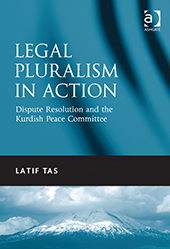
New Book Out: Legal Pluralism in Action- Dispute Resolution and the Kurdish Peace Committee

23 11 2014

9781472422088 Latif Tas 

 Ashgate, 2014

 ISBN: 978-1-4724-2208-8

This groundbreaking book contributes to, and refocuses, public debates about the incorporation of plural approaches into the English legal system. The book specifically advances the recent, largely theoretical, discussions of Sharia legal practice by examining a secular method of dispute resolution as practised by the Kurdish Peace Committee in London. Following migration to the West, many Kurds still adhere to traditional values and norms. Building on these, they have adapted their customary legal practices to create unofficial legal courts and other forms of legal hybridisation. These practical solutions to the challenges of a pluralistic life are seen by Kurdish communities in the UK as applicable not only to British and transnational daily life, but also as a training ground for institutions in a possible future Kurdish state. The study provides a substantive evidence base using extensive ethnographic data about the workings of the Kurdish Peace Committee, examining detailed case studies in the context of the customs and practices of the Kurdish community. Based on an ethnographic and interdisciplinary approach, this book will be of interest to policy makers, socio-legal professionals, students and scholars of legal anthropology, ethnic minority law, transnationalism, diaspora, Kurdish, Turkish and Middle Eastern studies.

Contents: Introduction; Legal pluralism; Kurds in Turkey: the historical background; Kurds in the UK: settlements and processing of their needs; Marriage, rituals and conflicts in Kurdish society; Business and criminal disputes and their customary solutions; Concluding thoughts; Glossary; Bibliography; Index.

Click here for publisher’s website 


Call for Papers: International Statebuilding and Gender in the Middle East

22 11 2014

30 March 2015, London School of Economics

225px-London_school_of_economics_logo_with_name.svgDespite the active involvement of foreign governments and international agencies in statebuilding  in the Middle East, the need to analyse and assess their impact on gender relations in this region remains inadequately addressed. International statebuilding is justified on the grounds of generating or maintaining peace, political stability and democracy, yet its outcomes have not always been along those lines. Inadequate or ineffective inclusion of the wider society, especially women, in such processes has proven to be detrimental to achieving long-term peace and successful institutional reform, as the cases of Afghanistan, Sudan, Sierra Leone, Guatemala and Iraq indicate. Despite the adoption of the UN Security Council Resolution 1325 to address the need to involve women in such processes, questions around its effective implementation still arise.

This conference aims to look at the impact of the relationship between international, national and local actors on the level of incorporation of gender in the processes of statebuilding in the Middle East. This call invites paper proposals on the following themes focusing on Iraqi Kurdistan and Iraq, as well as the rest of the Middle East and North Africa region:

1. Factors that inhibit and/or facilitate the incorporation of gender into international statebuilding:

  • Both successful and unsuccessful methods implemented by international actors in incorporating gender;
  • Domestic factors (social, legal, institutional, political, etc.) that enable and/or impede the incorporation of gender;
  • International normative, political and economic factors that prevent effective involvement of a gendered perspective;
  • The gap between the rhetoric of the UN Security Council Resolution 1325 and its implementation.

2. The impact of international statebuilding on women and gender relations in conflict-affected societies in relation to:

  • Mitigating the discrepancies between the priorities of powerful political actors and immediate needs of women;
  • The relationship between gender and security;
  • Women’s participation in public and political life and gender equality;
  • Social and political repercussions of internal and international population displacements on women of different ethnic and religious backgrounds.

3. Interactions between international, national and local actors in incorporating gender into political, social, economic and institutional transformation:

  • Connections and divisions between local and international actors (INGOs, local NGOs, policy-makers, UN organisations);
  • Implications of certain media discourses for gender relations, women’s status and peace prospects;
  • The role of women in political reconciliation as well as post-conflict peacebuilding and reformation and how this intersects with ethnicity, class, religion.

To apply

Proposals for 20-minute papers should comprise of a paper title, an abstract (250 words), a short biographical statement, contact details and affiliation. Please use the paper proposal form provided.

Applications for papers should be sent by email by 16 January 2015 to mec.events@lse.ac.uk.

Travel Grant

A small travel grant is available to help support speakers cover their travel and accommodation expenses. To apply for funding, please fill in the appropriate section in the paper proposal form. Speakers based in the UK and Europe can apply for up to 150 GBP, those based outside Europe can apply for up to 300 GBP. Expenses will be reimbursed after the conference and only on show of receipt.

More information

For more information, please contact Zeynep Kaya at z.n.kaya@lse.ac.uk or Ribale Sleiman-Haidar at r.sleiman-haidar@lse.ac.uk.

For details click here 


Call for provisional abstracts: The Sociolinguistics of Kurdish

19 11 2014

Workshop to be held at Societe Linguistique Europeenne 2015, Leiden, The Netherlands

Strict deadline for provisional abstracts (ca. 200 words) and expression of interest in participation: November 24, 2014.

Workshop proposal: The Sociolinguistics of Kurdish

Convenors: Margreet Dorleijn and Michiel Leezenberg

The fact that the Kurds are the largest nation in the world without a state of their own has given rise to a number of distinctive, and possibly unique, sociolinguistic features of their language. This panel aims at exploring some of these, and invites scholars working on Kurdish sociolinguistics to submit proposals concerning their research.

The new states that emerged after World War had different strategies of dealing with their Kurdish population groups, ranging from repression and assimilation to literization and standardization. In early Soviet Armenia, which only had a minute Kurdish minority, the Kurmanji dialect was developed into a fully functional medium for education, printing, and broadcasting in the late 1920s and early 1930s. The fledgling republic of Turkey, by contrast, pursued the most radically repressive policy, banning the public and private use of Kurdish in 1925; this ban remained in place until the 1990s, and its effects can still be seen today. In Iraq, a Southern dialect of Kurdish became an official language during the British mandate period; subsequent Iraqi regimes have not been able to undo or revert this official recognition of Kurdish. Remarkably, however, the present-day Kurdish Regional Government, which has had a constitutionally recognized autonomous status since 2005, has thus far largely refrained from formulating, let alone pursuing, any substantial linguistic policies. In Iran, Kurdish can be studied at universities, and books of Kurdish poetry can be published; but the use of Kurdish in elementary education and in administration has not been allowed.

Given these varying policies, the actual use of Kurdish is subject to a number of constraining factors. Although many Kurds dream of a unified and independent Kurdish state with a unified language, at the same time, there is considerable resistance from speakers of different dialects against proposals to create and impose a unified spoken and written variety.

Given this situation, an explicitly sociolinguistic approach towards the diversity of the linguistic situation of the Kurds is bound to yield fruitful insights.

For example, the persistence of variability and contestation of attempts at standardization may be fruitfully employed by having recourse to some of the more recent approaches in sociolinguistics that question long-held assumptions. Thus, Peter Trudgill’s recent ‘sociolinguistic typology’, (2011) which provides an alternative against the assumption of the equicomplexity of languages, or Jens Norman Jorgensen’s model of ‘polylanguaging’ which provides an alternative for the structuralist belief in languages as ultimately impenetrable holistic structures, and other recent approaches seem to offer fruitful ideas when dealing with standardisation in the linguistically diverse area that Kurdistan is.

Other topics for discussion include, but are not exhausted by, language contact, not only with the official languages of the states in which Kurds live (Turkish, Modern Standard Arabic, Persian), but also with locally spoken vernaculars of neighbouring peoples, like Armenian, Syriac, and dialectal Arabic; and by Kurdish linguistic ‘superdiversity’, i.e., the emergence of new varieties and blends of different languages spoken by Kurds, exemplified perhaps most visibly in Kurdish hiphop, which have emerged especially but not exclusively in emigration settings outside the Middle East. Pursuing such and other questions, we hope to help in calling more attention to the distinct trajectory of Kurdish and its speakers, not only in the Middle East, but in the present-day globalized world and media landscape at large.


Thus, questions that may be addressed in individual papers include (but are not restricted to) the following:

What is the prestige of Kurdish dialects among its speakers?

What is the actual vitality (in terms of actual usage) of Kurdish dialects among its speakers?

What is the impact of recent political changes and political turbulence on language policy in the area?

What is the extent of intra-dialect variation? And what is the prestige of the pertaining varieties?

What is the role, status and (mutual) influence of other languages spoken in the Kurdish region?

Are new contact varieties emerging and if so, what is their status?

What is the status, prestige and vitality of Kurdish among Kurds in the diaspora?

We welcome colleagues who are interested to send a provisional abstract before November 24th (strict deadline) to:

m.dorleijn@uva.nl

and/or

m.m.leezenberg@uva.nl


California State University & Kurdish American Education Society in Los Angeles Forum on the Political and Humanitarian Crisis in Syria and Iraq

16 11 2014

Csulb_sealDecember 3, 2014 – 12:00 NOON to 3:00 PM

CSULB University, Student Union, Beach Auditorium


OVERVIEW

The Syrian-Iraqi crises are deepening everyday as the Islamic State continues to expand its reign of terror in the changing political landscape of the Middle East, threatening ancient Mesopotamian religious and ethnic minorities with extinction. Humanitarian tragedies like that of the Kurdish Yazidis have led to the influx of millions of refugees with grave implications for regional and global peace and security. The forum will bring together leading experts including journalists, academicians, and scholars for lively discussions about the pressing historical, political, ethno-religious, cultural, issues, movements, and changes in Syria and Iraq.


PROGRAM

OPENING REMARKS

Amir Sharifi, CSULB Department of Linguistics


KEYNOTE SPEAKER

Reese Erlich: “A Reporter’s First Hand Report: Assad, ISIS, Obama and US Middle East Policy”

PANEL DISCUSSIONS

Gerard Russell: Researcher, author of Heirs to Forgotten Kingdoms: Yazidis and survival (via Skype)

James Gelvin: UCLA History: Social and cultural history of the modern Middle East, particularly Greater Syria

Sophia Pandya: CSULB Religious Studies: Religious change among educated women, and the implications of modernity, globalization, and education on their practice

Yousef Baker: CSULB International Studies: Globalization and development, social movements, nationalism, and migration in the modern Middle East and North Africa

Charlie Mahoney: CSULB Political Science: US foreign policy, terrorism, and counter-insurgency

Danny Paskin: CSULB Journalism and Mass Communication: International news coverage

Larry N. George: CSULB Political Science: international relations

Haider Helias: Yazidi Association president and representative

Nazand Begikhani: University of Bristol – Senior Research Fellow. Senior International Adviser on Higher Education & Gender/KRG, Editor-in-chief of Le Monde Diplomatique/Kurdish edition: The cases of Kurdish Yazidi women

Amir Sharifi: CSULB Linguistics: Kurdi`sh diaspora and socio-linguistic identity. The struggle for Political, cultural and linguistic autonomy


BOOK DONATION CAMPAIGN

15 11 2014
1925024_870300299661372_409366266562545539_nBook campaign for Mesopotamia Academy
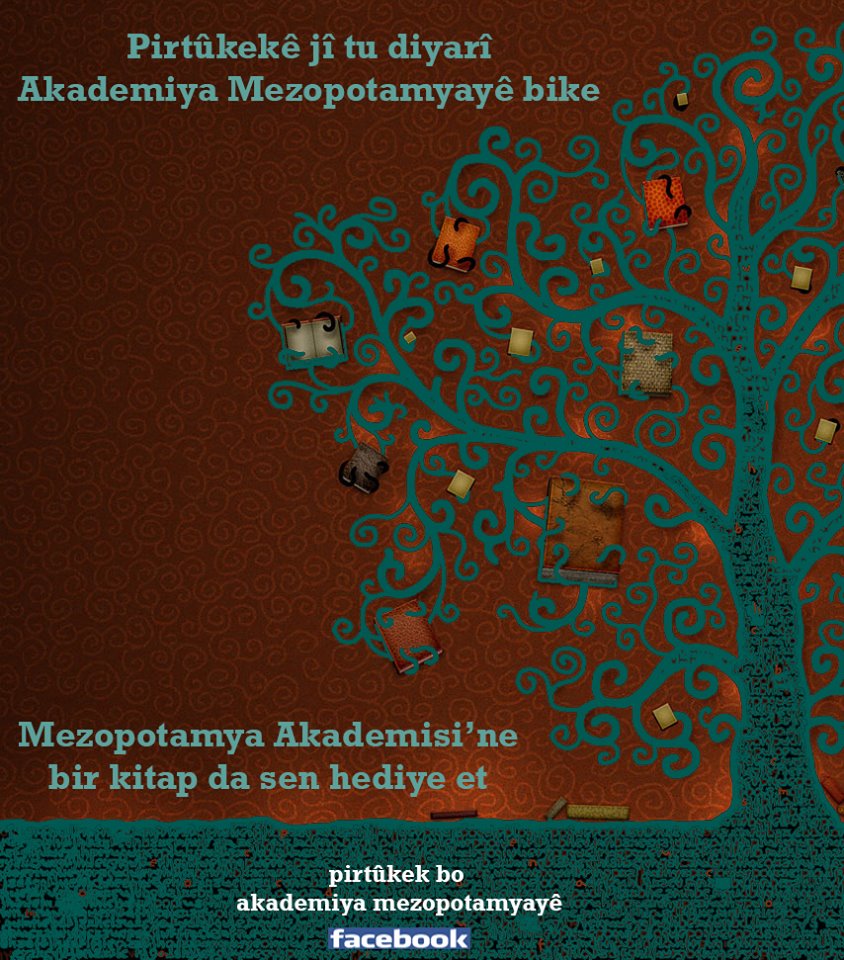
“A group of students from North and East Kurdistan, Turkey and European countries have launched a book campaing for Mesopotamia Academy of Social Sciences established on 2nd September in Qamişlo city of Rojava (West Kurdistan). Related to the campaign, the students have created a facebook page called “Pirtûkek bo Akademiya Mezopotamyayê – Donate a book to Mesopotamia Academy” and released a statement about the campaign. The students say they accept books in all languages, all areas and all levels. The donators can send their books to the addresses provided in their announcement. 
Call for the campaign is as following:
Book campaign for the Mesopotamia Academy of Social Sciences in Qamişlo
 
With the aim to establish a multilingual library for the first Kurdish university in Rojava – Mesopotamia Academy of Social Scienes – which was opened on 2nd September 2014, we, as a group of students from North Kurdistan, Turkey and Europe, are launching a book campaign. Our aim is to collect books in every language and from everywhere which will be donated to Mesopotamia Academy to establish a multilingual library.

People from abroad can join the campaign in two ways: (1) they can collect books in their located country and can send them via courier to the adresses given below or (2) they can buy books on the internet and send them to the adresses.

The primary responsibilty is on the shoulders of students to raise awareness to the campaign. We call on everyone to support the Mesopotamia Academy of Social Scienes that aims to build an educational system based on democracy, freedom and equality.

We believe that any aid sent to Rojava will contribute to establish day by day a free and common society and that the coexistence of Peoples will be strengthened.Since its establishment, the Democratic Autonomous Cantons of Rojava have made big efforts in this direction and raises hope to the peoples.

To strengthen this hope and move these efforts forward, we are excited to launch the campaign with the aim to establish an extensive library which is an essential need for the Academy. We invite you to be part of this excitement and show solidarity to expand the campaign.”

Facebook/ Pirtûkek bo Akademiya Mezopotamyayê – Donate a book to Mesopotamia Academy

https://www.facebook.com/pages/Pirt%C3%BBkek-bo-Akademiya-Mezopotamyay%C3%AA-Donate-a-book-to-Mesopotamia-Academy/870057249685677?fref=nf

 Source: hawarnews (Wednesday, 29 October 2014 15:16)


Call for Papers: Transformed Nations: State Policies in Kurdish- Populated Areas of Syria, Iraq, Turkey and Iran

15 11 2014

ifea-logoTransformed Nations: State Policies in Kurdish-Populated Areas of Syria, Iraq, Turkey and Iran. A comparative approach from a transnational perspective

January 23rd, 2015 – French Institute for Anatolian Studies (IFEA), Istanbul

In 2013, the French Institute for Anatolian Studies (IFEA, Istanbul), the French Institute for the Near East (IFPO, Erbil) and the University of Exeter, with the help of Aix- Marseille University, launched a common research program aiming at understanding the redefinition of relations between States and Kurdish-populated areas in the current regional context characterised by an intensification of transnational dynamics.

A first workshop was organized in June 2014 in Erbil. It aimed at analysing local modes of government in Kurdish-populated areas with a special focus on the role of political parties’ practices and ways to control territory.

The objective of the second workshop that will be held in Istanbul in January 2015 is to carry on this reflection while addressing the question of the production of State policies in Kurdish-populated areas in Syria, Iraq, Turkey and Iran. The production of State policy has often been described within a binary framework of analysis opposing the States’ actions and the societies of these regions. On the contrary, this workshop intends to give room for contributions with sociological, anthropological, contemporary history, political geography, political science or public policy approaches taking into account the non-unitary nature of the State and the multiple interactions between state authorities and local population or elites, and the role of transnational dynamics in the policy- making process.

In doing so, the workshop also aims at distancing itself from any kind of nationalist narrative that could leave in the shadow the decisive importance of national, local and transnational contexts. The predominance of coercive and repressive State policies should not let us overstate the specificity of these regions regarding State policy-making even if other factors have to be taken into account. The current intensification of relations between the different Kurdish-populated areas of the region can indeed be considered as an opportunity to question the effect of increasing regional interdependency links on State transformation. The role and power of the State, the level of autonomy of the Kurdish-populated areas, the different kinds of policy-making processes and the patterns of conflicts vary across countries of the region. Nevertheless civil wars in Syria and in Iraq and the ambiguities of the Turkish or Iranian regimes on the Kurdish issue in their domestic and foreign policies are putting into question in every country both the evolving nature of State policies and of their sovereignty in this cross-border space.

Call for papers_Workshop_January2015


Lecture: Violence Remembered, Violence Lived The Islamic State, Genocide and the Yazidis of Iraq

14 11 2014

20111107_NIOD_logoNIOD Institute for War, Holocaust, and Genocide Studies Lecture:  Violence Remembered, Violence Lived The Islamic State, Genocide and the Yazidis of Iraq (Friday 21 November, 13.30 – 17.00 h.)

The Yazidi minority of Iraq considers the rise of the Islamic State and the subsequent persecution of Yazidis to be the 73rd massacre in their history. This gathering focuses on the Yazidi experience of exterminatory violence. In drawing on empirical research we will analyze the historical memory of violence among Yazidis, as well as the current violence which embroils them. We will also consider critical issues in the international community’s response to this humanitarian crisis.

With lectures by:

Eszter Spät (Department of Medieval Studies, Central European University)

Fazil Moradi (Max Planck Institute for Social Anthropology and University of Halle)

Kjell Anderson (NIOD Institute for War, Holocaust, and Genocide Studies)

Uğur Ümit Üngör (NIOD Institute for War, Holocaust, and Genocide Studies)

The lectures are followed by a discussion (chair: Dr. Nanci Adler, NIOD Institute for War, Holocaust, and Genocide Studies).


Conference: The Future of the Kurds in the Middle East – November 24, 2014.

13 11 2014

logo-white-true-e1411679876274The threat of ISIS and the Kobane crisis have led to interesting developments in the  region. The Turkish government declared that it gives Peshmerga forces a passage to Kobane as a response to Washington’s approval of arms transfers to PYD. For the first time, the White House publicly stated that PYD is different from PKK, and thus, not considered as a terrorist group by the United States. Recently, PYD and Syrian Kurdish parties reached a settlement in Dohuk in the presence of KRG President Massoud Barzani, reminiscent of the Erbil agreement two years ago.

Will the United States support an autonomous Kurdish region in Syria? Is the Dohuk agreement going to be effective under the pressure of ISIS threat? What is the stance of Turkish government toward PYD’s future?

Join us at Rethink Institute for a conversation on the future of Kurds in the Middle East with renowned experts Michael M. Gunter (Tennessee Technological University), Vera Eccarius-Kelly (Siena College), and Sezin Oney (Taraf daily).

Speakers: 

MICHAEL M. GUNTER is  professor of political science at Tennessee Technological University where he teaches courses on international relations and American foreign policy. He is the author of 11 books on Kurds in the Middle East, most recently Out of Nowhere: The Kurds of Syria in Peace and War (London: Hurst Publications, 2014).

VERA ECCARIUS-KELLY is Professor of Comparative Politics and Associate Dean at Siena College in Albany, New York. She is the author of The Militant Kurds: A Dual Strategy for Freedom(Santa Barbara, CA: Praeger International).

SEZIN ONEY is columnist for Taraf daily in Turkey. She conducts a weekly news analysis program at Açık Radyo (Open Radio), offering a comparative angle analyzing Turkey’s politics with European politics, and global affairs.

Moderator

MUSTAFA GURBUZ is fellow at Rethink Institute and a policy fellow at Center for Global Policy at George Mason University. He is the author of Transforming Ethnic Conflict: Rival Kurdish Movements in Turkey (Forthcoming, Amsterdam University Press).

For details click here 


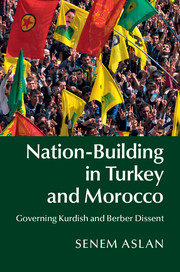
New Book: Nation-Building in Turkey and Morocco Governing Kurdish and Berber Dissent

10 11 2014

9781107054608 Senem Aslan

 Cambridge University Press, 2014

  •  ISBN: 9781107054608


 Why do some ethno-national groups live peacefully with the states that govern them, whereas others develop into serious threats to state authority? Through a comparative historical analysis, this book compares the evolution of Kurdish mobilization in Turkey with the Berber mobilization in Morocco by looking at the different nation-building strategies of the respective states. Using a variety of sources, including archival documents, interviews, and memoirs, Senem Aslan emphasizes the varying levels of willingness and the varying capabilities of the Turkish and Moroccan states to intrude into their citizens’ lives. She argues that complex interactions at the ground level – where states have demanded changes in everyday behavior, such as how to dress, what language to speak, what names to give children, and more mundane practices – account for the nature of emerging state-minority relations. By taking the local and informal interactions between state officials and citizens seriously, this study calls attention to the actual implementation of state policies and the often unintended consequences of these policies.

For publisher’s website click here


New Book: Iraqi Federalism and the Kurds – Learning to Live Together

10 11 2014

9781409451112 Alex Danilovich

Ashgate, 2014

  •  ISBN: 978-1-4094-5111-2


  •  Iraq today faces a whole gamut of problems associated with post-war recovery and state-rebuilding compounded by age old       mistrust and suspicion. The situation in Iraq resembles a huge experiment in which social scientists can observe the consequences of actions taken across an entire country. Can Western ideas take route and flourish in non-western societies? Can constitutionalism take hold and work in a traditional religious and deeply divided society? Is Iraqi federalism a solution to the country’s severe disunity or a temporary fix?

    Iraqi Federalism and the Kurds: Learning to Live Together addresses these important questions and focuses on the role of federalism as a viable solution to Iraq’s many problems and the efforts the Kurdish government has deployed to adjust to new federal relations that entail not only gains, but also concessions and compromises. The author’s direct experience of living and working within this embattled country allows a unique reflection on the successes and failures of federalism and the positive developments the introduction of federal relationships have brought.

            Click here for publisher’s website 


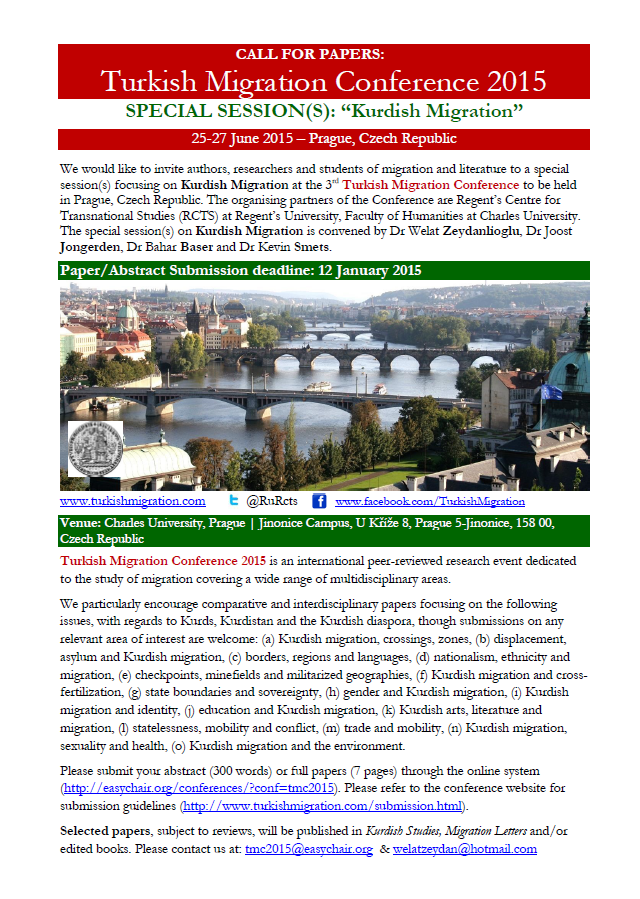
Call for Paper: “Kurdish Migration”

8 11 2014

kurdimigcfp

The Turkish Migration Conference 2015  (25-27 June 2015, Prague) invites authors, researchers, and students of migration and literature to a special session focusing on Kurdish Migration. The special session is convened by Dr. Welat Zeydanlioglu, Dr. Joost Jongerden, Dr. Bahar Baser, and  Dr. Kevin Smets.

Abstract submission deadline : 12 January 2015

The convenors particularly encourage comparative and interdisciplinary papers focusing on the following issues, with regards to Kurds, Kurdistan and the Kurdish diaspora, though submissions on any relevant area of interest are welcome: (a) Kurdish migration, crossings, zones, (b) displacement, asylum and Kurdish migration, (c) borders, regions and languages, (d) nationalism, ethnicity and migration, (e) checkpoints, minefields and militarized geographies, (f) Kurdish migration and cross- fertilization, (g) state boundaries and sovereignty, (h) gender and Kurdish migration, (i) Kurdish migration and identity, (j) education and Kurdish migration, (k) Kurdish arts, literature and migration, (l) statelessness, mobility and conflict, (m) trade and mobility, (n) Kurdish migration, sexuality and health, (o) Kurdish migration and the environment.

Turkish Migration Conference 2015 is an international research event dedicated to the study of migration to, from, in and through Turkey covering a wide range of multidisciplinary areas including dynamics and patterns of human mobility, legal and regulatory frameworks, labour market outcomes, education and human capital, brain drain and brain circulation, short term migrations, migrant integration, diasporas, culture, media and politics, health and well-being of migrants, internal and international migration nexus, migrant experiences, the cost of migration, legal frameworks, conflicts, non-movers and attitudes and policies towards migration and migrants. The theme for this years, conference is set as “Economics, Identities, and Geographies” to reflect the multifaceted and multidisciplinary nature and scope of the field.

Turkish Migration Conference 2015 brings together practitioners, academics, and students from a broad range of disciplines including anthropology, demography, economics, law, psychology, sociology, development studies, health sciences, political science, international relations, media and communications, and other cognate disciplines with a focus on human mobility from Turkey, in Turkey and to Turkey. Inter-disciplinary research and comparative perspectives are particularly encouraged. Turkish Migration Conference features invited talks, parallel and special sessions, workshops, and policy sessions where practitioners, politicians and media representatives will discuss Turkish migration. There are opportunities for side-meetings and social activities.


Kurdish Studies Scholars’ Statement of Solidarity and Call for Action to Support Kobani

7 10 2014

The humanitarian crisis caused by the Islamic State (IS) continues to terrorize and displace hundreds of thousands of people in the Middle East. The autonomous canton of Kobani is now bearing the brunt of the IS’s attacks as the international community has mostly been passive. The city has been under siege for three weeks. Despite fierce resistance by the defenders of the town, the advance of the IS forces towards Kobani is threatening to set off another massacre similar to that of Shengal. As scholars working on issues related to the Kurds and other peoples of Kurdistan, we are profoundly concerned about yet another imminent humanitarian crisis and stand in solidarity with the people of Kobani. We urgently call on the coalition forces against the IS and the broader international community to take immediate action to prevent an impending disaster by supporting the Kurds in their fight for self-defense.
We view the situation in Kobani as one of self-defense against the military aggression of the IS, notorious for its macabre forms of violence against ethnic and religious minorities. The defenders of the city of Kobani have repeatedly and desperately tried to bring their predicament to the attention of the world community and called for more focused and effective air strikes against IS targets around Kobani in coordination with the political authorities and resistance fighters of Rojava (Western Kurdistan). They are once again asking for diplomatic and political recognition, weapons of self-defense, and humanitarian aid to protect themselves against the relentless onslaught of IS. They are too ill-equipped to be able to fend off the most advanced American and Russian arsenals used by the IS. If global support is not provided immediately, they may not be able to withstand the IS’s incessant bombardments; tomorrow may be too late.

We fully support Kobani’s demands and spirit of self-defense and call on the international coalition forces and the broader international community to support Kobani immediately. In expressing our solidarity, we need to stress the fact this statement is not a call for any military aggression or occupation, including that of the Turkish military. We encourage the Turkish government to negotiate with the Kurdish representatives in good faith to ensure the ongoing peace process, which holds much promise. As Kurdish political representatives of Rojava have repeatedly declared, if they are recognized as a legitimate authority and provided with the needed weaponry and other support, they are capable of driving away the threat of the IS.

Ultimately our appeal for extending the necessary support to Kobani has as much to do with the survival of a pluralistic city and its residents, as it has to do with the defense of freedom everywhere else.

List of Signatories

  1. Gulan Abuzeyit, Brock University
  2. Yasemin Acar, Claremont Graduate University
  3. Dr. Necla Acik, University of Manchester
  4. Asst. Prof. Salih Can Aciksoz, University of Arizona
  5. Yılmaz Adal, Koc University
  6. Maria Chiara Addis, European Food Safety Authority
  7. Dr. Hashem Ahmadzadeh, Institute for Research and Development-Kurdistan/Iraq
  8. Assoc. Prof. Ananth Aiyer, University of Michigan-Flint
  9. Ahmet Hamdi Akkaya, Ghent University
  10. Asst. Prof. Elçin Aktoprak, Ankara University
  11. Prof. Nadje Al-Ali, University of London
  12. Taimoor Aliassi, Association for Human Rights in Kurdistan of Iran-Geneva
  13. Sacha Alsancakli, Université La Sorbonne nouvelle, Paris
  14. Assoc. Prof. Jennifer Alvey, University of Michigan-Flint
  15. Asst. Prof. Seda Altug, Bogazici University, ATA Institute
  16. Asst. Prof. Ali Ashouri, California State University, San Diego
  17. Delal Aydin, Binghamton University
  18. Dr. Yavuz Aykan, Université Paris I (Panthéon-Sorbonne)
  19. Azad Aziz, Manchester Academic Health Sciences Centre
  20. Sonay Ban, Temple University
  21. Hanifi Baris, University of Aberdeen
  22. Asst. Prof. Felek Baran, Hakkari University
  23. Dr. Derya Bayir, Queen Mary, University of London
  24. Carol Benedict, Winona State University
  25. Dr. Bahar Beser, Coventry University
  26. Dr. Daria Bocharnikova, Harvard University
  27. Dr. Joanna Bocheńska, Jagiellonian University
  28. Firat Bozcali, Stanford University
  29. N. Argun Cakir, University of Exeter
  30. Prof. Antonio Callari, Franklin and Marshall College
  31. Eray Cayli, University College London
  32. Omer Celebi, Yildiz Technical University
  33. Adnan Celik, Paris EHESS
  34. Filiz Celik, University of London, Birkbeck
  35. Onder Celik, Johns Hopkins University
  36. Dr. Behrooz Chamanaram, Georg-August-University, Goettingen
  37. Abdul Haque Chang, University of Texas at Austin
  38. Faculty Emeritus Jeff Clark, James Madison University
  39. Lynne Colley, Exeter and Soran Universities
  40. Assoc. Prof. Vahap Coşkun, Dicle University
  41. Prof. Hamid Dabashi, Columbia University
  42. Asst. Prof. Mahiye Secil Dagtas, University of Waterloo
  43. Cevat Dargin, New York University
  44. Engin Emre Deger, Istanbul Sehir University
  45. Dilara Demir, Rutgers University
  46. Yunus Demir, Istanbul Bilgi University
  47. Davide Denti, University of Trento, Italy
  48. Yasemin Dildar, University of Massachusetts, Amherst
  49. Dr. Dilsah Deniz
  50. Dogan Dogan, Canadian Kurdish Federation
  51. Dr. Adis Duderija, University of Malaya
  52. Deniz Duruiz, Columbia University
  53. Esin Duzel, UC San Diego
  54. Dr. Vera Eccarius-Kelly, Siena College
  55. Asst. Prof. Ozge Ejder, Mimar Sinan Fine Arts University
  56. Deniz Ekici, independent Researcher
  57. Baban Eliassi, Geneva University
  58. Dr. Turgut Ercetin, Stanford University
  59. Ilgin Erdem, University of Massachusetts-Amherst
  60. Dr. Umut Erel, Open University
  61. Lara Fresko, Cornell University
  62. Resul Geyik, Mardin Artuklu University
  63. Dr. Maria Giedz, Gdansk School of Banking
  64. William Gourlay, Monash University
  65. Onur Gunay, Princeton University
  66. Asst. Prof. Azat Zana Gundoğan, University of Michigan-Flint
  67. Aziz Guzel, York University
  68. Serra Hakyemez, Johns Hopkins University
  69. Emad Hamedi, University of St Andrews
  70. Wendelmoet Hamelink, Leiden University
  71. Prof. Katharine Hodgkin, University of East London
  72. Susan Jahoda, University of Massachusetts, Amherst
  73. Dr. Karolina Jaworska, University of Silesia
  74. Maruf Kabi, University of St Andrews
  75. Karol Kaczorowski, Jagiellonian University
  76. Erkan Karacay, University of Exeter
  77. Fethi Karakecili, York University
  78. Emine Rezzan Karaman, UC Los Angeles
  79. Seref Kavak, Keele University
  80. Dr. Serap A. Kayatekin, The American College of Thessaloniki
  81. Dr. Janroj Keles, Middlesex University
  82. Pinar Dinc Kenanoglu, London School of Economics
  83. K. Mehmet Kentel, University of Washington, Seattle
  84. Dr. Mehmet Rauf Kesici, Kocaeli Universtiy and Regent’s University
  85. Mina Khanlarzadeh, Columbia University
  86. Ugur Kocak, University of Chicago
  87. Prof. Anna Krasnowolska, Jagiellonian University
  88. Asst. Prof. Bulent Kucuk, Bogazici University
  89. Mehmet Barış Kuymulu, City University of New York
  90. Benjamin Kweskin, Independent Scholar
  91. Patrick Lewis, University of Chicago
  92. Andrew Littlejohn, Harvard Univesity
  93. Assoc. Prof. Yahya M. Madra, Bogazici University
  94. Assoc. Prof. Kamran Matin, Sussex University
  95. Ibrahim Malazada, Brunel University
  96. Caroline McKusick, University of California, Davis
  97. Fatma Derya Mentes, Duke University
  98. Dr. Sabah Mofidi
  99. Della Murad, Gulan
  100. Veronica D. Musa LL.M., Human Rights Lawyer, Argentina
  101. Prof. Leyla Neyzi, Sabanci University
  102. Assoc. Prof. Bruce Norton, San Antonio College
  103. Francis O’Connor, European University Institute, COSMOS
  104. Dilan Okcuoglu, Queen’s University
  105. Dr. Ahmet Feyyad Oncel
  106. Dr. Ergin Opengin, University of Bamberg
  107. Prof. Emeritus Baskin Oran, Ankara University
  108. Omer Ozcan, University of Texas at Austin
  109. H. Ege Ozen, Binghamton University (SUNY)
  110. Prof. Umut Ozkirimli, Lund University
  111. Asst. Prof. Ceren Ozselcuk, Bogazici University
  112. Asst. Prof. Hisyar Ozsoy, Univesity of Michigan-Flint
  113. Assoc. Prof. Ayse Parla, Sabanci University
  114. Zozan Pehlivan, Queen’s University
  115. Naomí Ramírez Díaz, Autónoma University of Madrid
  116. Asst. Prof. Renata Rusek-Kowalska, Jagiellonian University
  117. Sardar Saadi, University of Toronto
  118. Prof. George Saliba, Columbia University
  119. Berivan Kutlay Sarikaya, University of Toronto
  120. Cafer Sarikaya, Bogazici University
  121. Marlene Schäfers, University of Cambridge
  122. Dr. Thomas Schmidinger, University of Vienna, Austria
  123. Ceren Sengul, University of Edinburgh
  124. Dr. Serap Ruken Sengul, University of Michigan-Ann Arbor
  125. Dr. Amir Sharifi, California State University, Long Beach
  126. Assoc. Prof. Said Shams, Soran University
  127. Assoc. Prof. Jaffer Sheyholislami, Carleton University
  128. Mushtaq Ul Haq Ahmad Sikander, Kashmir University
  129. Spyros A. Sofos, Lund University
  130. Asst. Prof. Kamal Soleimani, Mardin Artuklu University
  131. Rina Srabonian, University of Manchester
  132. Dr. Latif Tas, Oxford University
  133. Assoc. Prof. Kumru Toktamis, Pratt Institute Brooklyn, NY
  134. Asst. Prof. Hakan Topa, SUNY Purchase College
  135. Vedat Toprak, Anadolu University
  136. Zenonas Tziarras, University of Warwick
  137. Özden Melis Ulug, Bremen University
  138. Secil Uluisik, University of Arizona
  139. Laura Unger, Independent Researcher,
  140. Kerem Ussakli, Stanford University
  141. Asst. Prof. Nazan Ustundag, Bogazici University
  142. Prof. Abbas Vali, Bogazici University
  143. Dr. Anand Vaidya, Harvard University
  144. Prof. Nicole F. Watts, San Francisco State University
  145. Dr. Nerina Weiss, Fafo Institute for Applied International Studies, Norway
  146. Assoc. Prof. Kamala Visweswaran, University of Texas at Austin
  147. Assoc. Prof. Aziz Yagan, Dicle University
  148. Prof. Mesut Yegen, Istanbul Sehir University
  149. Ismail Yigit, Mississippi State University
  150. Dilan Yildirim, Harvard University
  151. Emrah Yildiz, Harvard University
  152. Yesim Yaprak Yildiz, University of Cambridge
  153. Asst. Prof. Zeynep Turkyilmaz, Dartmouth College
  154. Asst. Prof. Zehra Yilmaz, Van Yuzuncuyil University
  155. Cagri Yoltar, Duke University
  156. Dr. Deniz Yonucu, independent researcher
  157. Asst. Prof. Zafer Yörük, Izmir University of Economics
  158. Assoc. Prof. Grazyna Zajac, Jagiellonian University, Poland
  159. Dr. Goran A.S. Zangana, Health Policy Research Organization, Kurdistan/Iraq
  160. Dr. Asli Zengin, Yörük University
  161. Dr. Charlotta Zettervall, Malmö University
  162. Dr. Welat Zeydanlioglu, Kurdish Studies Journal Editor, Sweden
  163. Prof. Zvi Zohar, Bar-Ilan University
  164. Dr. Farangis Ghaderi, Exeter University
  165. Duygu Çelik, Istanbul University, Turkey
  166. Dr Jalal Nori, Stockholm University
  167. Servet Erdem, University of Oxford
  168. Fateh Saeidi, Georg-August University
  169. Gulcan Sezer, independent researcher, Holland
  170. Assoc. Prof. Yılmaz Özdil, Mardin Artuklu University
  171. Dr. Hiva Panahi, Panteion University
  172. Prof Zeynep Gambetti, Bogazici University
  173. Dr Recep Dogan, independent researcher, Turkey
  174. Seyfettin Cabuga, Fatih University
  175. Asst. Prof. Marina Taloyan, Karolinska Institute, Sweden
  176. Osman Isci, Hacetepe University, Turkey
  177. Dr. Firat Gundem, Dokuz Eylul University, Turkey
  178. Dr. David Selim Sayers, San Francisco State University
  179. Dr. Evrim Emir-Sayers, San Francisco State University
  180. Ihsan Gunduz, George Mason University
  181. Ass. Prof. Umut Tümay Arslan, Mimar Sinan Fine Arts University
  182. Dr. John Huynyk, independent researcher, London, UK.
  183. Dr. Salih Akin, University of Rouen
  184. Asst. Director, Christian Sinclair, University of Arizona
  185. Betul Rifaioglu, University Sussex
  186. Dr. Rûken Alp, Sabanci University
  187. Dr. Zerrin Ozlem Biner, University of Cambridge
  188. Navid Naderi, Duke University
  189. Dr. Cuma Cicek, SciencesPo de Paris/CERI
  190. Firat Capan, Hacetepe University
  191. Ceren Zeynep Ak, Queen Mary, University of London
  192. Jan Bojer Vindheim, Norway
  193. Asst. Prof. Ali Kemal Özcan, Tunceli University
  194. Prof. Michael Leezenberg, Amsterdam University
  195. Didem Oral, European University Institute
  196. Özgür Sevgi Göral, Ecole des Hautes Etudes en Sciences Sociales (EHESS)
  197. Ahmet Alış, Bogazici University
  198. Z. Asli Elitsoy, Bilkent University
  199. Massoud Sharifi Dryaz, Ecole des Hautes Etudes en Sciences Sociales (EHESS)
  200. Bekir Halhalli, Comenius University in Bratislava
  201. Asst. Prof. Selim Temo, Mardin Artuklu University
  202. Gulay Turkmen- Dervisoglu, Yale University
  203. Pinar Kemerli, Bard College, Cornell University
  204. Djene Bajalan, American University of Iraq – Sulaimani
  205. Dr. Nadia Jones-Gailani, University of South Florida
  206. Dr. Sebahattin Topcuoglu, independent, Hamburg, Germany
  207. Dr. Farhad Shakely, Uppsala University
  208. Asst. Prof. Barış Ünlü, Ankara University
  209. Kajal Mohammadi, York University, Canada
  210. Mehtap Tosun, Middle East Technical University
  211. Kumru Bilici, Carleton University, Canada
  212. Shayee Khanaka, librarian, University of California, Berkeley
  213. Dr. Ipek Demir, University of Leicester
  214. Mardin Aminpour, The university of Texas at Austin
  215. Assoc. Prof. Osman Aytar, Malardalen University, Sweden
  216. Kawa Morad, University of Exeter
  217. Ozcan Ogut, University of Pompeu Fabra
  218. Prof. Ali Akay, Mimar Sinan Fine Arts University
  219. Ülker Sözen, Mimar Sinan Fine Arts University
  220. Emine Iğdi, Free University of Amsterdam
  221. Assoc. Prof. Jaffer Sheyholislami, Carleton University, Canada
  222. Dr. Gérard Gautier, Institut National des Langues et Civilisations Orientales, Paris
  223. Dr. Eszter Spät, Käte Hamburger Kolleg, Ruhr-Universität Bochum
  224. Demet Arpacık, CUNY Graduate Center, New York
  225. Charlotte M. Sáenz, Adjunct Associate Faculty, California Institute of Integral Studies, USA
  226. Shenah Abdullah, University of Sulaimani-Kurdistan, Iraq
  227. Dr. Zhala Azad, University of Sulaimani-Kurdistan, Iraq
  228. Assoc. Prof. Besime Sen, Mimar Sinan Fine Arts University
  229. Asst. Prof. Ceren Belge, Concordia University
  230. Dr. Boris James. Institut Français du Proche-Orient
  231. Shna Kurdi, independent researcher, UK
  232. Prof Izettin Önder, Istanbul University
  233. Alev Yıldırım, CUNY Graduate Center, New York
  234. Tugba Yildirim, EHESS, France
  235. Berrin Altin Soran, University of Leicester
  236. Yeşim Mutlu, Middle East Technical University
  237. Daniel Barry, CUNY Graduate Center, New York
  238. Sibel Yardımcı, Mimar Sinan Fine Arts University
  239. Murat Cemal Yalçıntan, Mimar Sinan Fine Arts University
  240. Dr. Behrooz Shojai, Mardin Artuklu University
  241. Arda Gucler, Northwestern University
  242. Dr. Azad Henareh, United States Department of Agriculture
  243. Deniz Cifti, Exeter University
  244. Senem Guneser, Free University of Brussels
  245. Prof. Christine Allison, Exeter University
  246. Safak Kilictepe, Indiana University
  247. Ulaş Özdemir, Yıldız Technical University
  248. Dr. Kariane Westrheim, University of Bergen
  249. Muhammad Waladbagi, Durham University
  250. Assoc. Prof. Benjamin Smith, University of Florida
  251. Dr. Clemence Scalbert-Yucel, University of Exeter/Institut Français des Etudes Anatoliennes
  252. Assoc. Prof. Maya Arakon, Süleyman Sah University
  253. Gulden Ozcan, Carleton University, Canada
  254. Asst. Professor, Juan Obarrio, Johns Hopkins University
  255. Asst. Prof. Senem Aslan, Bates College
  256. Erden Ilter, Binghamton Universtity, USA
  257. Dr. Katharina Brizić, University of California, Berkeley, Berkeley Language Center
  258. Prof. Adriano V. Rossi, L’Orientale University, Napoli, Italy
  259. Kardo Bokani, Assistant Lecturer, University College Dublin
  260. Prof. Hamit Bozarslan, Ecole des Hautes Etudes en Sciences Sociales (EHESS)
  261. Dr Ozlem Galip, University of Oxford
  262. Latif Yilmaz, Middle East Technical University, Turkey
  263. Hakan Sandal, Istanbul Bilgi University, Turkey
  264. Prof. Gulistan Gurbey, Free University of Berlin
  265. Dr. Kariane Westrheim, University of Bergen
  266. Dr. Minoo Alinia, University of Uppsala
  267. Sara Belelli, University of Naples, Italy
  268. Dr. Cengiz Gunes, The Open University, UK
  269. Birgul Yilmaz, SOAS, University of London
  270. Nazan Bedirhanoglu, Ankara University
  271. Dr. Murat Issi, University of Panteion, Greece
  272. Deniz Cenk Demir, McGill University, Canada
  273. Veronica Buffon, University of Exeter
  274. Dr. Anna Grabolle-Celiker, independent researcher, Turkey
  275. Can Cemgil, Istanbul Bilgi University, Turkey
  276. Shahab Vali, Artuklu University, Turkey
  277. Behnam Amini, York University, Canada
  278. Francesco Marilungo, Exeter University, UK
  279. Schluwa Sama, Philipps-University Marburg, Germany
  280. Prof. Veena Das, John Hopkins University, USA
  281. Assoc. Prof. Naveeda Khan, John Hopkins University, USA
  282. Assoc. Prof. Clara Han, John Hopkins University, USA
  283. Dr. Mustafa Akcinar, University of Zurich
  284. Yasamin Moein, Istanbul Bilgi University, Turkey
  285. Dr. Azer Kilic, Koc University
  286. Dr. Salima Tasdemir. independent researcher, Turkey
  287. Zeynep Kocak, European University Institute
  288. Katrine Scott, Lund University
  289. Senem Guneser, Free University of Brussels
  290. Izettin Onder, Bogazici University, Turkey
  291. Assoc. Prof. Seckin Aydin, Batman University, Turkey
  292. Elif Genc, New School for Social Research, USA
  293. Dr. Thomas Schmidinger, University of Vienna
  294. Ozgur Cicek, Binghamton University, USA
  295. Dr. Handan Caglayan, Ankara University, Turkey
  296. Gustavo Espeja, independent researcher, Argentina
  297. Mithat Ishakoglu, University of Exeter, UK
  298. Dr. Maria Six-Hohenbalken, Institute for Social Anthropology, Austria
  299. Dr Tove Skutnabb-Kangas, independent researcher, Sweden
  300. Özgür Bal, Middle East Technical University, Turkey
  301. Prof. Adriano V. Rossi, L’Orientale University, Italy
  302. Dr. Olivier GROJEAN, Aix-Marseille Université, France
  303. Beyan Farshi, Simon Fraser University, Vancouver, Canada


Third Issue of Kurdish Studies Out Now

5 10 2014

1234201_625109010844964_781824838_nKurdish Studies 

Volume 2, Issue 2

ISSN: 2051-4883 | e-ISSN: 2051-4891

Special Issue on Kurdish Linguistics 

This special issue of Kurdish Studies is dedicated to studies of the Kurdish language, the oldest branch of Kurdish studies, and the first to find a degree of academic institutionalisation. Compared to other major Middle Eastern languages, Kurdish has received relatively little serious investigation, but there is a gradually growing corpus of empirical and theoretical research, of which the guest editors give a useful overview in the introduction.

Kurdish Studies journal is an interdisciplinary and peer-reviewed journal dedicated to publishing high quality research and scholarship. Kurdish Studies journal is initiated by the members of the Kurdish Studies Network (KSN) and supported by a large group of academics from different disciplines. The journal aligns itself with KSN’s mission to revitalise and reorient research, scholarship and debates in the field of Kurdish studies in a multidisciplinary fashion covering a wide range of topics including, but not limited to, economics, history, society, gender, minorities, politics, health, law, environment, language, media, culture, arts, and education.


Table of Content

Editorial

Martin van Bruinessen

Articles:

Introduction to Special Issue – Kurdish: A Critical Research Overview

Geoffrey Haig and Ergin Öpengin

On the Linguistic History of Kurdish

Thomas Jügel

Regional Variation in Kurmanji: A Preliminary Classification of Dialects

Ergin Öpengin and Geoffrey Haig

Badini Kurdish Modal Particles dê and da: Procedural Semantics and Language Variation

Christoph Unger

Diversity in Convergence: Kurdish and Aramaic Variation Entangled

Paul M. Noorlander

Book Reviews:

Kariane Westerheim, Michael Gunter, Yener Koc, Yavuz Aykan, Diane E. King, Jordi Tejel, Joost Jongerden, Martin van Bruinessen.


For further details, contact:

Welat Zeydanlioglu

Managing editor

editor@kurdishstudies.net

Kurdish Studies is a peer-reviewed scholarly journal.

ISSN: 2051-4883 | e-ISNN: 2051-4891 |http://www.kurdishstudies.net/


Conference Announcement: Second International Conference on Variation and Change in Kurdish

5 09 2014


Screen_Shot_2014-06-25_at_3.58.58_PMDate: 8-9th October 2014

Place: Department of Kurdish Language and Culture, Institute of Living Languages, Mardin Artuklu University, Mardin/Turkey

The last two decades have witnessed a rapid increase in interest for the Kurdish language, within both academia in the narrow sense and in the fields of educational policies, and in Kurdish arts and literatures. Although a number of important advances have been made in all these areas, within Kurdish linguistics, there remains a persistent lack of theoretically informed and empirically grounded research on actual language usage, and the various dimensions of variation within the Kurdish speech community: regional, age-based, gender-based, attitudinal, or socio-economically motivated. Likewise, there have been few serious attempts at relating synchronic variation to diachronic change.

This conference aims to bring together scholars working on different varieties of Kurdish and neighbouring languages who share an awareness and appreciation of variation as pivotal in the analysis of contemporary Kurdish and in reconstructing its historical development.

For details click here


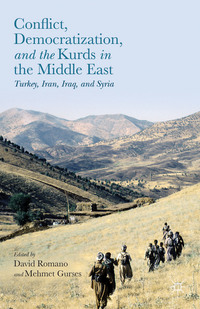
New Book: Conflict, Democratization, and the Kurds in the Middle East

24 08 2014

Edited by David Romano and Mehmet Gürses9781137409980

August 2014

ISBN 9781137409980

Palgrave Macmillan

In Turkey, Iran, Iraq, and Syria, central governments historically pursued mono-nationalist ideologies and repressed Kurdish identity. As evidenced by much unrest and a great many Kurdish revolts in all these states since the 1920s, however, the Kurds manifested strong resistance towards ethnic chauvinism.
What sorts of authoritarian state policies have Turkey, Iraq, Iran and Syria relied on to contain the Kurds over the years? Can meaningful democratization and liberalization in any of these states occur without a fundamental change vis-à-vis their Kurdish minorities? To what extent does the Kurdish issue function as both a barrier and key to democratization in four of the most important states of the Middle East? While many commentators on the Middle East stress the importance of resolving the Arab-Israeli dispute for achieving ‘peace in the Middle East,’ this book asks whether or not the often overlooked Kurdish issue may constitute a more important fulcrum for change in the region, especially in light of the ‘Arab Spring’ and recent changes in Turkey, Iraq, Iran and Syria.

Click here for publisher’s website 


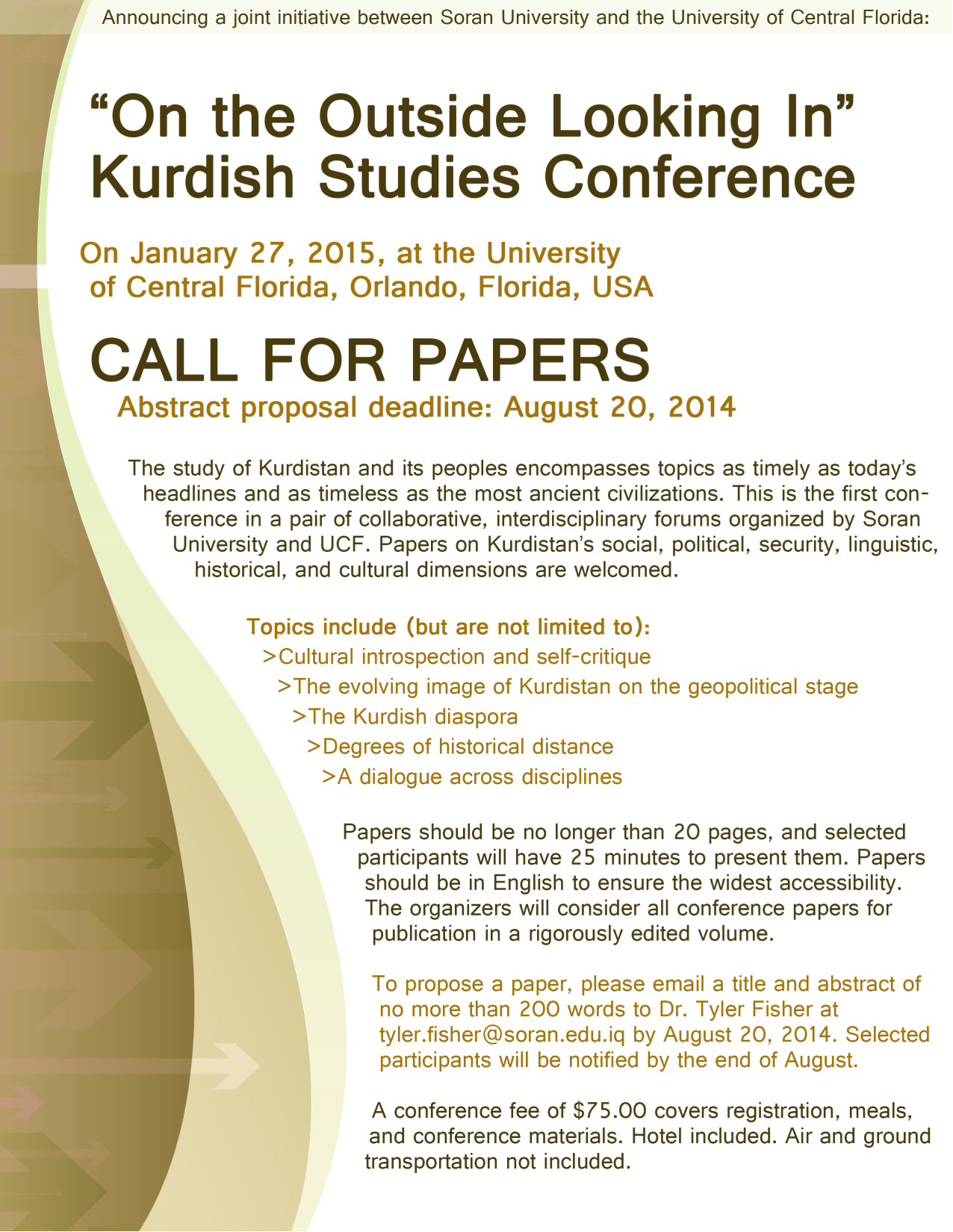
Call for Papers: Kurdish Studies Conference “On the Outside Looking In”

21 08 2014

image001The study of Kurdistan and its peoples encompasses topics as timely as today’s headlines and as timeless as the most ancient civilizations. For the first conference in a pair of collaborative, interdisciplinary forums organized by Soran University and University of Central Florida, the organizers invite papers on Kurdistan’s social, political, security, linguistic, historical, and cultural dimensions. In keeping with the conference theme, the organizers particularly welcome papers that deal with questions of cultural introspection and self-critique, the evolving image of Kurdistan on the geopolitical stage, the Kurdish diaspora, degrees of historical distance, and dialogue across disciplines.

Papers will be delivered in English and should be no longer than 20 pages, and participants will have 25 minutes to present them. The organizers will consider all conference papers for publication in a rigorously edited volume.

To propose a paper, please send a title and abstract of no more than 200 words to Dr. Tyler Fisher at tyler.fisher@soran.edu.iq.


Iranian Studies Dedicates Special Issue on Kurdish Studies

7 08 2014

Iranian_Studies_Journal

Iranian Studies

Volume 47, Issue 5, 2014

ISSN: 0021-0862 | e-ISSN: 1475-4819

http://www.tandfonline.com/toc/cist20/current#.U-O0xuN_uZg


The latest issue of the Iranian Studies journal, published on behalf of the International Society for Iranian Studies,  is dedicated solely to Kurdish Studies. “This present special issue is an attempt to contribute to the growing debate and discussion surrounding the Kurds and their history.  It seeks to showcase the work of a number of scholars who look at important historiographical questions related to the Kurds and the historical evolution of their identity, why certain groups in the Middle East have identified themselves or have been identified as  Kurds and how this has impacted political developments. The following articles address various aspects of Kurdish identity in diverse chronological periods within both the pre-modern and modern eras through the lens of history.” (Djene Bajalan and Sara Zandi Karimi, Guest Editors’ Introduction).

As one of the outspoken aims of the Kurdish Studies Network (KSN) is to revitalize scholarship within this discipline, this special issue is regarded as enrichment to literature. The KSN congratulates the authors and researchers involved in this special issue, of which some are members of the KSN as well.